









06 — Mother, Father, Family
- Every person here is fictional. The school is only ever "the Academy".
1. The shape of the family
The Hallorans are a Boston political dynasty. From the street they look complete: a senator, his elegant wife, a golden son, a quiet little girl.
From inside, the family is three people and a chair.
- The nucleus: Cate, Declan, Ari. Breakfasts, beaches, bedtime, the summer.
- The chair: Patrick's place at the table. Set every night. Usually empty.
- The family next door: the Vails. Conrad, Eleanor, Sterling, little Julian. Every Christmas Eve, every Maine summer, every christening. So close nobody can say where one family stops.
- The ghost behind them: Edmund Halloran, the grandfather who built the name and expects it to keep climbing.
- The secret beside them: a second family in Milan that only Ari knows exists.
After October of Year 0, the nucleus is two. The Vails close around it like a hand. That is the story: the hand that comforted her is the hand that held her brother under.
2. Catherine "Cate" Halloran (née Ashby) — the mother
Who she was
- Old Boston money, the quieter kind: the Ashbys gave to hospitals and libraries and never ran for anything.
- Married into the noise. She liked Patrick's energy when they were young. She thought she could be the calm center of a loud life.
- The real center of the house. She ran it, raised the children, wrote the thank-you notes, smiled through fundraisers, and covered for Patrick's absence so smoothly the children rarely heard her complain.
- Warm, funny, a little reckless in private. She taught Declan to sail and Ari to swim. She danced in the kitchen when Patrick was away, which was most nights.
- Where Ari's humor comes from. Cate was the funniest woman at any table before grief took it. Ari inherited the timing. Ari kept it; Cate lost it.
- Eleanor Vail is her best friend. Twenty years of shared summers, school runs, charity boards and late kitchen wine.
The summer
- Year 0 in Italy was her idea as much as his, or so she believed. She wanted the four of them somewhere the Senate could not reach.
- In Milan she was happy. At Porto Santa Margherita she was happier: long beach days, the lagoon light at evening, the trips into Venice where Declan dragged everyone up bell towers.
- She photographed everything. Those photographs become the only shrine she keeps.
The night
- She stays home in Boston with Ari. Not at the gala: Ari has a fever, and Patrick is in Washington for a vote.
- 4:05 a.m.: the state police ring the Beacon Hill house. Cate answers in the front hall. Ari, on the stairs, reads it on her face before a word is said.
- What Cate never learns: that her husband knew two and a half hours before she did, and didn't call her.
- The first person at her door that morning is Eleanor Vail, still in her gala shoes, straight from hosting the breakfast. Eleanor holds her all day. It is real, and it is also where Eleanor needs to be.
After Declan
- Grief took most of her. She never fully comes back.
- She stops sailing. She stops dancing. She keeps Declan's room exactly as it was for years.
- She turns her love toward Ari, but it comes out as worry and distance at the same time: hovering, then gone for days in a dark bedroom.
- She believes the official story because the alternative would kill her. Drunk, slipped, struck his head. She repeats it until it sounds like a prayer. It's Harriet Kessler's sentence; Cate never knows whose words she's praying.
- The grandchildren bring part of her back. With Maeve and Dec she laughs again, a little. She calls Dec by his full name, every time.
How she sees Ari
- She sees a quiet, sensible daughter who never needs anything. That is the best gift Ari can give her, so Ari gives it every day.
- She thinks Ari is "a little old for her age" and "takes after the Ashbys." She has no idea what her daughter is.
- She never knew about Milan. Ari decided at five that she never would.
- The marriage to Julian is Cate's happiest day since Year 0. "Eleanor and I always said." Ari lets her have it, and after Year 26 has to keep letting her have it.
Her crack in Ari's armor
- Ari loves her mother without conditions, and that love is the one thing Ari has never been able to engineer.
- The cruelest risk in the whole story: anything Ari does to the 22 could bring the truth of the night back to Cate. Ari plans around it like a load-bearing wall.
- Year 27 makes it worse. Cate loses her best friend in "the fog off the point" and grieves Eleanor as she grieved Declan. Ari sits beside her at the funeral, holding her hand, knowing exactly how Eleanor died and exactly what Eleanor did. She never tells her either.
3. Patrick Halloran — the father
Stanford: the friend
- Freshman year, Year −26. Patrick Halloran, the governor's son from Boston, and Conrad Vail, the scholarship-sharp kid who already talked like a lawyer, share a corridor and then a life.
- What each gives the other: Patrick has the name; Conrad has the nerve. Conrad drafts Patrick's first campaign speech in a dorm room. Patrick gets Conrad into the rooms where Boston money sits.
- Best friends for life, publicly and privately. Best man at each other's weddings. Conrad is Declan's godfather. Patrick is Julian's.
- The bond is real. That matters. Patrick never stops loving Conrad, and that's why the call is possible.
The man in public
- Charming, tireless, persuasive. The rare politician people describe as "genuinely kind" after one handshake.
- The heir. State legislature, then the US Senate from Massachusetts at Ari's age one, then President at her age twenty-four.
- A great speech about family. He gives it often. After Year 0 it has a line about Declan. The line always lands.
The man at home
- Always working, always away, never present.
- Even at the beach in Year 0 he never came. A vote, then another. Every night at Porto Santa Margherita the hotel set a place for him and a waiter took it away, until Conrad Vail, who flew in with his family for the last three days, sat in it. He called from Washington, and that was the summer.
- He loves his children the way he loves the country: sincerely, in general, from a distance.
- Ari's earliest memory of him is the back of his coat going out the door.
The other life
- Why Milan: Patrick's second family is there. Giulia Benedetti, and their daughter Chiara, two years younger than Ari.
- His "trade meetings" and "constituent travel" to Italy over several years were partly real and partly cover.
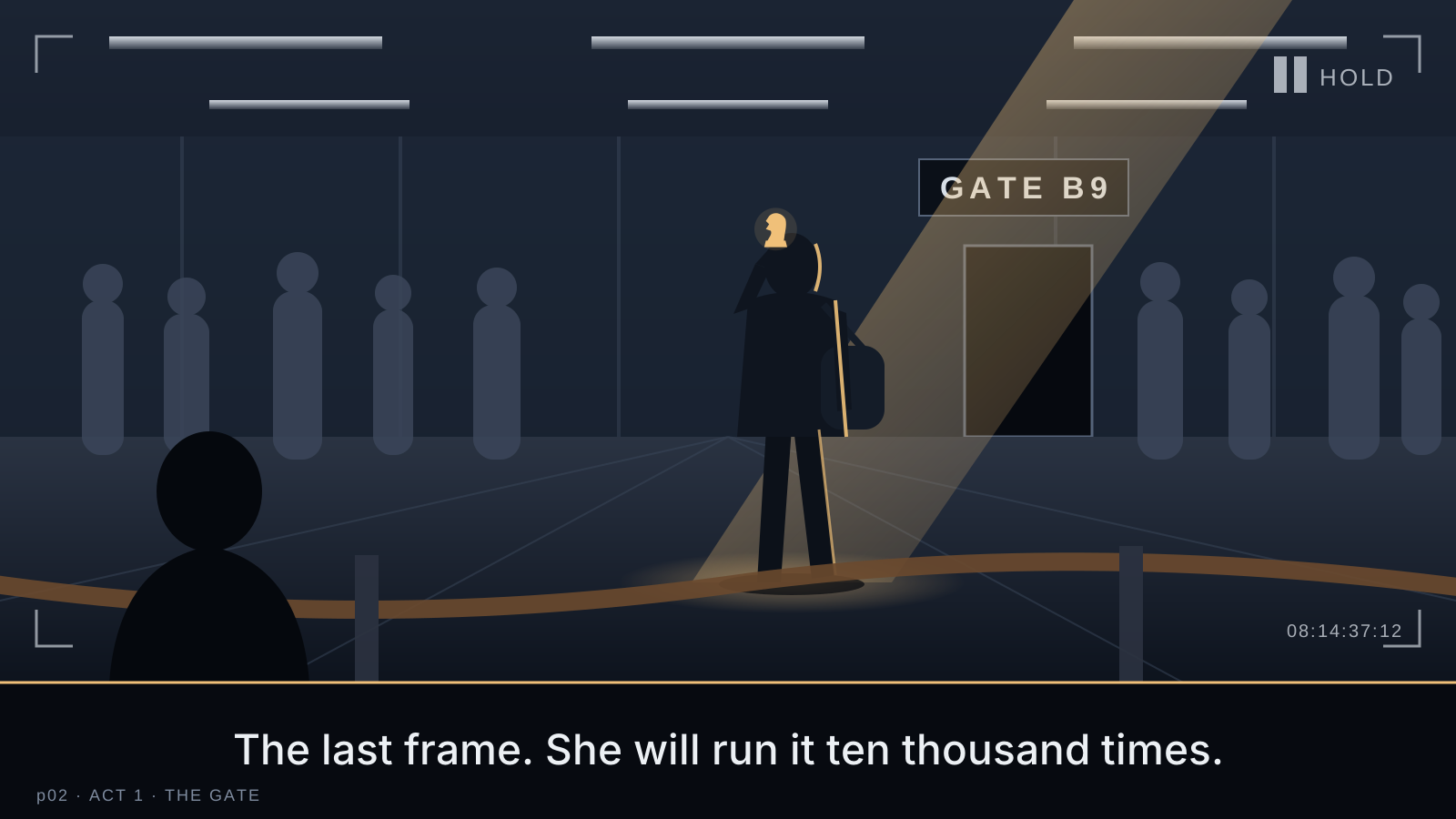
- The café moment (Year 0, summer): Patrick steps away from the family table "to take a call." Cate, her back to the window, sees nothing. Through the café window Ari sees him greet a woman and a small girl. It lasts four seconds. His shoulders, his hand on the child's hair, the way his face changes into someone she has never met. At five she reads the whole thing in one look.
- She tells no one. Not Declan. Not her mother. Not, in twenty-eight years, anyone.
- Conrad knows. He has always known. He helped set Giulia up in the flat.
The night: one phone call
- Patrick is not on campus. He is in Washington for a Senate vote, in a rented townhouse on Capitol Hill, awake in the study, reading a briefing after the late vote.
- 1:41 a.m. The phone rings; he answers on the second ring. Conrad, alone at the trustees' table in the emptied great hall, voice steady because it has to be. He tells him everything: Declan is dead. Sterling did it. Nothing can undo it.
- "Help me save the son I still have."
- Patrick is quiet for a long time. Long enough for Conrad to say his name twice.
- Then: "Do what you have to. I'll handle my end."
- What "my end" means: before dawn, one call to one senior aide. The aide calls the county attorney, Gordon Pike, who owes Patrick his job, on Sunday night; Pike rules on Monday. Later, a Senate office that will release one statement and take no questions.
- Then he hangs up and does not call his wife. He sits in the study with the lamp on for two hours and twenty-six minutes. At 4:07 Cate calls him, two minutes after the state police rang Boston. He answers on the first ring, awake, and does the voice of a man hearing it for the first time.
- No record of it except the call itself, which sits in a carrier log for twenty-eight years until his daughter finds it.
Why he said yes
Three reasons, in the order he admits them to himself:
- Nothing could bring Declan back. Conrad's sentence, and it's true. Two dead sons or one.
- Conrad. Twenty-six years of friendship. Declan's godfather begging for his own boy. Patrick could not be the man who ended the Vails.
- The career. A senator's son dead at a drunk party is a tragedy. A senator's son killed by his best friend's son, in front of thirteen children of trustees and CEOs, with a cover-up already two hours old, is the end of everything. He never lets this one all the way into the light.
The canon line: he traded his dead son's truth for his best friend's living son, and for the career.
Why she never read him
She reads everyone. She read every face at the funeral and remembered every one. She never read her father. Three reasons, stacked:
- He was never there. At the funeral he stood at the back of the church on the phone, then left early for a car. At home, the chair. You can't read a face you never get to watch.
- She'd already found his secret. At five, through a café window in Milan, she caught him in a lie so big she thought it was the lie. She filed him: the man with the other family. Having found one secret, she stopped looking for a second. Milan was the decoy he never knew he'd planted.
- She was looking for hands. Her search was for who was in the boathouse. Patrick was four hundred miles away. The list was built on presence; he had an alibi made of absence.
The one time he showed it, she misread it. Year 18, Julian proposes. Patrick takes her aside on the porch of the Vail summer house, the only time in her life he asks her a personal question: "Are you sure? About this family?" She thinks it's a father being a father, late. She is looking at Julian through the window. She laughs and says, "Dad, you introduced us. I was four." He nods, and never asks again.
After Declan: ambition as guilt
- The rule he says out loud: "No one will ever have power over my family again."
- What it really is: guilt in a suit. He climbs because standing still means thinking. Every rung is proof the yes was worth it.
- The irony Ari sees only at the end: the one man with power over his family is the one he handed it to. Conrad holds the call. Conrad holds Milan. Conrad becomes his biggest donor in Year 2, his kingmaker, and gives him floor 250 "for my oldest friend." Patrick calls him "the best friend this family ever had," and means it, and it's also a leash.
- He never lets himself be alone with Sterling. Christmas Eve, Maine, Ari's wedding: he shakes Sterling's hand, asks about the fund, and finds a reason to be somewhere else. Nobody notices but Eleanor.
- He gives his daughter to the Vails. He watches her marry the brother of the boy who killed his son, with Conrad giving the toast and Sterling standing as best man. He tells himself it's healing: the two families made one, the debt finally closed. He says nothing. The same silence, at a higher price.
- He holds his grandson. At Dec's christening he hears Conrad say his dead son's name over the font. He smiles for the photographer. It is the only photograph of him Ari later can't look at.
Year 27: losing Conrad
- Conrad, Eleanor and Sterling are "lost in fog off the point." Patrick loses his best friend.
- He gives the eulogy. He has given a hundred; he can't finish this one.
- He begins to wonder. The boat, the fog, the timing, his daughter's composure at the graveside. He's not the reader she is, but he's a politician; he knows a story that's been agreed on, because he once agreed to one.
- He never asks her. Once, in the car after the funeral, he asks Brannock one question about the weather that night, and never a second. Asking her would mean explaining why he suspects. The 22nd name lands harder because of this: he did it for the family she married into, and now that family is gone and he can't grieve it honestly either.
How he sees Ari
- He doesn't. He sees a credit to the family: good grades, no scandals, a useful face on a campaign stage.
- He brags about "my daughter at MIT" and "my daughter at Harvard Law" and could not name one thing she actually loves.
- At her Harvard graduation he leaves before the reception for a call.
- He has never noticed she's funny. He laughs, looks surprised every time, and forgets by dinner. She's wickedly funny everywhere, but he's never there long enough for it to add up. Staffers quote her one-liners back to him; he assumes they're his.
- She still wants him to see her. That is her oldest wound after Declan, and she hates that it still works.
- The quiet joke at the center of the book: the President of the United States runs on a surveillance program that his daughter steers, inside his own White House, through his own Chief of Staff, and he has never once looked at her closely enough to wonder. She never looked at him closely enough either. That's the symmetry.
- Opening day, early January, Year 28, the last week of his term. At dusk he cuts the ribbon in the Crown lobby. On her phone, through Lanternwell, the last file opens: a carrier-log line, one call, 1:41 a.m., the Vail phone to Patrick's Washington line, 4 min 12 s. No. 22.
- Expose him: the call, the film and the 22 go out on the network's live feed.
- Spare him: she closes the file and never speaks of it.
- Leave him knowing she knows — default, drafted.
- Default draft:
- The ribbon falls. Cameras up. She steps in to kiss her father's cheek for the photograph.
- At his ear, under the applause, four words: "One forty-one, Dad."
- She feels it land. For the first time since Milan she reads his face all the way down, and it's all there: the lamp in the study, the long silence, Conrad saying his name twice.
- She smiles for the cameras, squeezes his hand, and walks away.
- He stands under the lights holding the scissors, smiling, for the rest of his term and the rest of his life. He'll never know what she'll do with it. That's the sentence.
- Why the default works: it's the only punishment that fits a man whose crime was a silence. She gives him one back.
4. The Vails — the family next door to everything
The Vails are not neighbors. They're the other half of the Hallorans. The closeness is the camouflage.
The rhythm of the two families
- Christmas Eve at the Vails' house on Beacon Hill, three streets from the Hallorans', every year since before Ari was born. Eleanor's oyster stew. Conrad's toast. The kids' table.
- Maine: the Vail summer house on the point, where the Hallorans have their own room. July is both families on one porch.
- Every christening, graduation, campaign night. Conrad's at every victory party, one step behind Patrick, usually holding his drink.
- What it gives Ari: a second family when hers has a chair and a shrine in it. Eleanor is the aunt who notices her. The Vail house is warm and loud, the way Beacon Hill was before Year 0.
Who they are to her
- Conrad Vail (No. 2): "Uncle Conrad." Declan's godfather. Wept at the grave, and the grief was real. Taught her chess openings at seven, never guessing she'd already beaten Declan. The man who ran the cover-up hour by hour.
- Eleanor Vail (No. 15): her mother's best friend, the hostess every family wants, warm and exact. The first to Cate's door that morning. The one who walked Sterling out through the inn's kitchen at 1 a.m. and burned his clothes.
- The only Vail who half-sees Ari. Eleanor notices things. Late in the marriage she says, over the dishes, "You're the cleverest one in this family, aren't you? You just don't let anyone catch you at it." Ari makes a joke. Eleanor laughs, and keeps watching.
- Sterling Vail (No. 1): thirteen years older, the glamorous almost-cousin who vanished to Geneva the night Declan died and came back a stranger with a hedge fund. Generous with presents, rarely in the room. Julian's best man. The hands in the film.
Why she filed them under family
- Their grief was real. At five she learned to read guilt; real grief was the one thing that hid it. The Vails had both, and the grief was louder.
- They were inside the circle she was protecting. You don't search your own house.
- They never acted guilty, because they didn't feel it. That's the lesson of the night: power means never facing consequences. The Vails believed it more completely than anyone on the list.
When the search lands (Year 26)
- Vane's offline film: Sterling's hands, Conrad's headlights, Eleanor's coat.
- The answer has been at her own dinner table for twenty-six years. She keeps smiling at Sunday dinner. She passes Eleanor the salt.
- Year 27: the Vails learn she knows and plan her "accident." Julian kills his father, mother and brother at the summer house to protect her and the children. She covers it up before sunrise: a boat lost in fog. Never caught.
- What it leaves: floors 247, 248 and 249 dark on opening day. A Christmas Eve with no one to host it. Patrick without his best friend. Cate without hers.
Maeve Vail (born Year 21) and Declan "Dec" Vail (born Year 23)
- Maeve: sharp-eyed, watchful, funny early. Ari sees herself in her and is afraid of it. She makes very sure Maeve is allowed to be seen.
- Dec: named for her brother. Loud, brave, kind to his sister. Conrad holds him at the christening and has to say the name aloud over the font. Ari, who doesn't know yet, thinks Conrad's voice breaks from love.
Their bloodlines
- Grandchildren of the man who ran the cover-up and the man who signed it off. Both grandfathers are on the list.
- Nephew and niece of the boy who held Declan under.
- They are the only fully innocent Vails and Hallorans in the book. Everything Ari does after Year 26 is shaped around keeping them that way.
What the family is to them
- Two grandmothers, two grandfathers, an uncle with presents. Christmas Eve at Granny Eleanor's. Grandpa Patrick on television.
- Year 27: three of them gone in one night. Ari tells her children the agreed story: a boat, fog, an accident nobody could have stopped.
- The mirror: Harriet Kessler taught the agreed story to thirteen children in the small hours. Twenty-seven years later Ari teaches it to two. She is better at it. She makes it gentle. That's what makes it unbearable.
- Julian, after: their father is the man who saved them, and they'll never know it. He has to be a good father with that night inside him. Some days he can; some days Ari carries both of them.
- With the children: the escape takes all three of them, or all four.
- Without Julian: she takes the children and leaves him the one thing he can't share with them.
- Alone: she leaves the children with Julian and Cate, because a mother who vanishes is safer for them than one who's found. The hardest version.
- Rule for any version: the children never learn what either grandfather did, or what either parent did, from her.
6. Declan Halloran — the brother (as the family remembers him)
Declan has his own file. Here, only his place in the house.
- The sun of the family. Loud, funny, brave, kind to his little sister in the way older brothers rarely are. The first person who laughed at her jokes as if they were jokes, not cute.
- The one who saw Ari. He noticed her watching, played chess with her as an equal, and told her she was "the smart one, don't tell Dad."
- His room: third floor, overlooking the back garden. Cate keeps it as he left it after the summer: a swim-team ribbon, a Venice postcard tucked in the mirror frame.
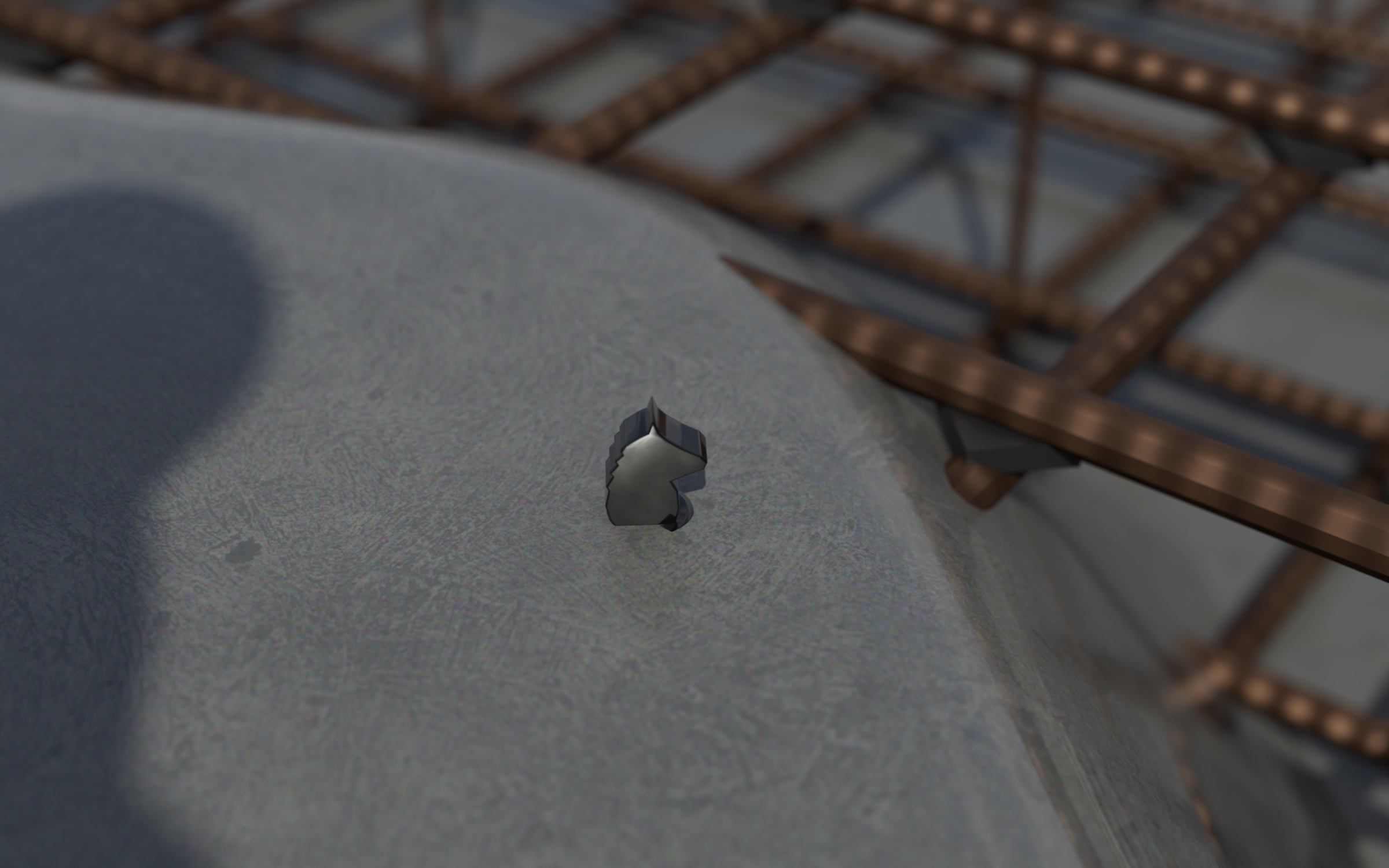
- The unfinished game isn't in the room. It's in Ari's head: the last evening at Porto Santa Margherita, folded mid-game "to finish at Thanksgiving." She knows the position by heart. The board and its box went with her; the knight never leaves her pocket.
7. The half-sibling twist — Chiara Benedetti
Who she is
- Born in Milan in Year −3, two years younger than Ari.
- Raised by her mother, Giulia Benedetti, a restorer of old frescoes and church glass.
- Grows up knowing her father is "an important American who cannot be with us." She does not know which one until she is old enough to search.
What Ari does about her
- Watches, never touches. From MIT onward Ari keeps a light, private eye on Chiara's life. School, work, health, money. Never contact.
- Protects her quietly. When the Halloran political machine comes close to discovering Giulia during the first presidential campaign (Year 18), a trail goes cold. Nobody knows why.
- Feels nothing simple. Chiara is the proof of her father's absence: the nights he was "working" were sometimes spent being someone else's father. Ari resents her and guards her at the same time.
- And she's the reason Ari stopped looking. Milan was the secret Ari thought she'd found. It hid the real one for twenty-eight years. Ari can't blame Chiara for that, and does a little anyway.
- Option A — the mirror. Chiara is everything Ari might have been with a present father: open, ordinary, loved. One meeting late in the story, in Milan, where Chiara does not know who Ari is. Love cracks Ari for an afternoon; she seals it.
- Option B — the lever. Conrad Vail has known about Milan since he found Giulia the flat. Milan plus the 1:41 call is the leash he's held on Patrick since Year 0. When Conrad dies in Year 27, Ari finds the Milan file in his papers and makes sure it dies with him.
- Option C — the escape door. Ari's exit plan quietly includes Chiara: a trust, a new name, a way out if the storm reaches her. Ari's escape becomes, in small part, a gift to the sister she never met.
- Tie to the 22: Lorenzo Castelvetri (No. 19) is from the same Milan circle. His family's glass and Giulia's restoration work could have crossed paths. A thin thread worth keeping.
Hard line
- Cate never learns about Chiara from Ari. If she ever learns, it comes from someone else, and that someone pays for it.
8. The reserve twist — Gideon Strand, the stepbrother
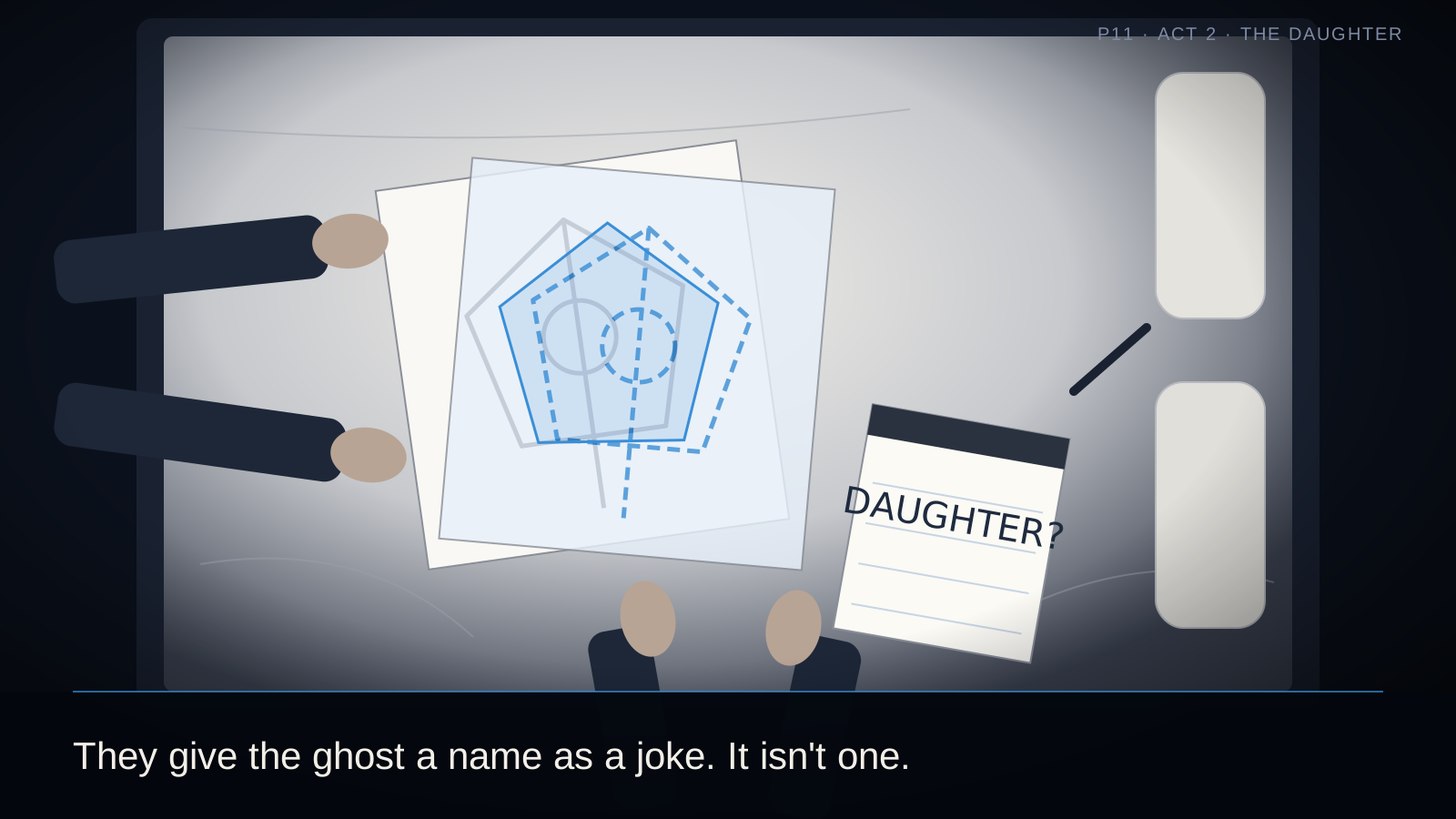
- Year 2: grief breaks Patrick and Cate's marriage. It ends quietly, with a joint statement about privacy. (What breaks it, though neither says so: Cate feels a silence in him she can't name. It's 1:41.)
- Year 3: Cate marries Aldous Strand, a widowed Boston developer. He is gentle with her, and that is real.
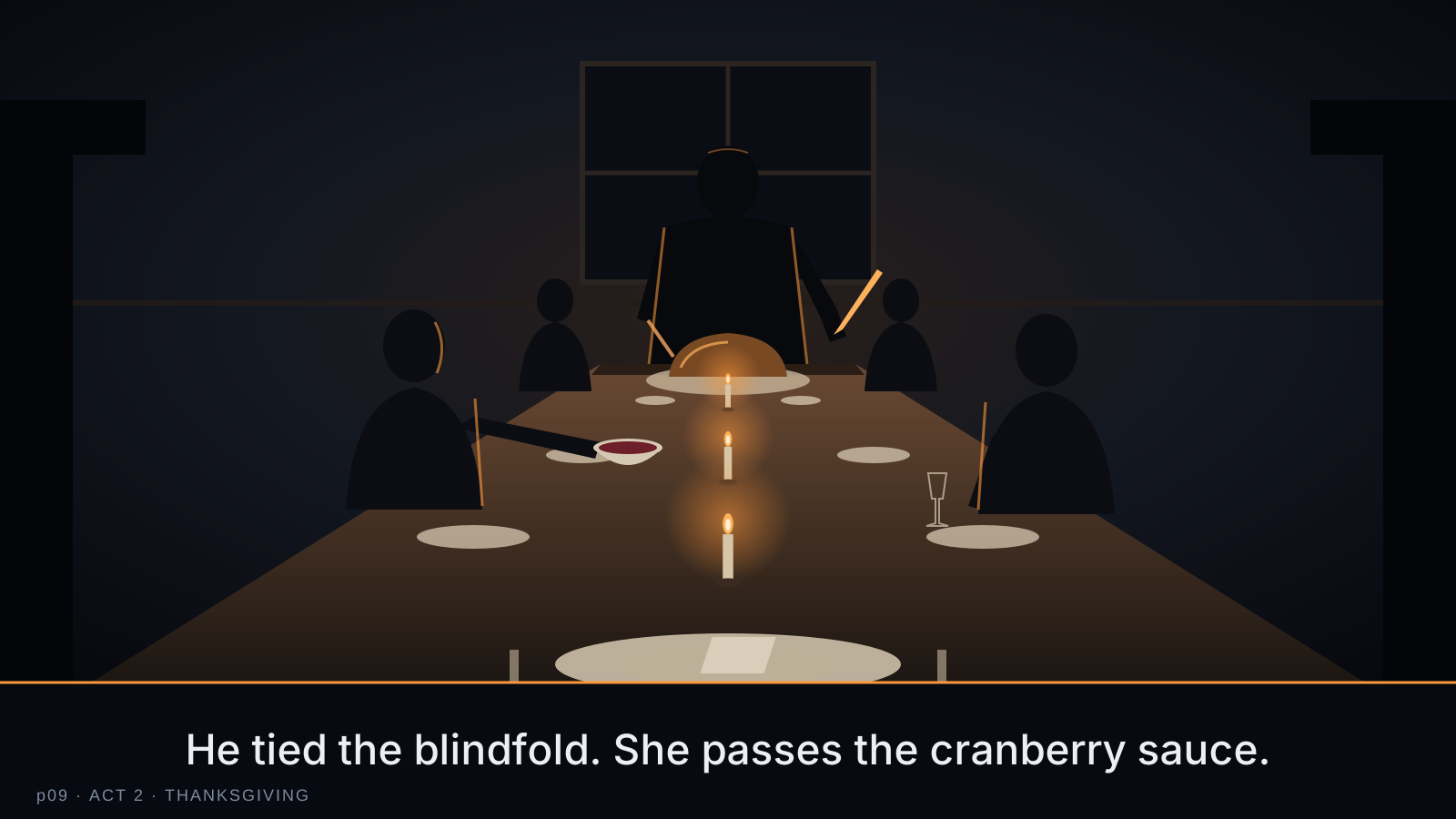
- Gideon Strand (No. 14, tied Declan's blindfold) becomes Ari's stepbrother. He is twenty, she is eight.
- Thanksgiving, every year: Ari passes the potatoes to the boy who blindfolded her brother. He is kind to her. That makes it worse.
- The tower: Gideon becomes developer of record. Ari has been feeding him the idea since Oxford. He thinks the vision is his.
- Cate's position: if this twist is used, Cate married into the 22 without knowing, on top of a best friend who was on it. Her second chance at happiness sits on floor 244.
- The Vails stay close either way. Christmas Eve survives the divorce; Eleanor makes sure of it.
- If not used: the marriage holds, cold and formal, and Patrick and Cate share a roof the way they share a stage.
9. The house in Boston
Where and what
- A Beacon Hill townhouse, red brick, black shutters, five stories, on a gaslit street that slopes toward the river. (Address invented.)
- Bought by Edmund Halloran when he was governor. The family's political address for two generations.
Room by room
- The front parlor: where donors are received. Portraits of Edmund. Patrick's photographs with world leaders (all invented equivalents). A framed photo of Patrick and Conrad at Stanford, arms around each other, on the mantel.
- The dining room: the long table with Patrick's chair at the head. Ari counts the nights it is filled. In Year 0 it is filled eleven times.
- The kitchen: the warm room. Cate dancing, Declan stealing food, Ari doing homework that was too easy for her.
- The front hall: where the 4:05 call comes. Ari, on the stairs in her nightgown, reads it on her mother's face before anyone speaks. The hall stays the coldest place in the house for her. She doesn't learn until Year 28 that the call she remembers was the second one.
- Declan's room, third floor: kept as a shrine.
- Ari's room, fourth floor: small, plain, deliberately boring. A child's room that never quite grew up, because nothing in it may ever reveal who she is. Her real life never lives here.
- The roof: a narrow deck with a view across the river. Where she and Declan watched the Fourth of July fireworks. Where, at night, she still goes to think.
What the house means
- A stage. Christmas card photos, campaign interviews, the perfect family.
- A tomb. After Year 0, the third floor goes silent.
- A cover. Nobody looks for a genius in a house full of politics. Everybody is watching Patrick.
10. How none of them see what she is
The whole family looks straight at her for thirty-three years and never sees her. That is partly their blindness and mostly her design.
Why they miss it
- Patrick is never there. You cannot notice what you never look at.
- Cate is drowning. A mother in grief sees a daughter who is "fine," and needs her to be fine.
- Declan saw it, and he is gone. The one person who knew she was the smart one died before he could tell anyone.
- Edmund sees an asset. A granddaughter for photographs, not for power. He was wrong about that, and never knows.
- The Vails see family. Except Eleanor, who sees a little, and decides it's charming.
- Julian sees the real her and calls it "you." He sees the humor, the speed, the way she knows the end of every sentence. He thinks it's just who she is with him. He's right, and has no idea what else it is.
Why she lets them miss it
- At five, she decides. The day after the funeral she understands that being seen is dangerous. People who are seen get managed, used or stopped.
- The test at six. The record says 220. The family hears "gifted" and moves on. The real number, 475, never reaches the house.
- The performance: good but not great grades, polite but not memorable, interested in harmless things. The B+ at MIT is the adult version of a performance she started in grade school.
- The humor is part of it. The funniest person at the table is the last one anyone suspects. When she's in the mood she's devastating, quick and dry and wicked, and the room relaxes and shows her everything.
- No tells at home. She never fixes the household Wi-Fi, never corrects her father's staff, never finishes the crossword faster than her mother. Small restraints, every day, for decades.
Moments that almost crack it
- Year 1, the chessboard: Cate finds Ari on the floor of Declan's room with the folding board from Porto Santa Margherita open in front of her, set to the position they never finished. Ari says she is "just remembering." In fact she is playing out the game move by move and finding the win Declan missed.
- Year 9, Switzerland: a headmaster's letter home hints that something about Ari "is not ordinary." Patrick's office files it. Nobody reads it.
- Year 18, the porch: Patrick asks "Are you sure? About this family?" The one time he almost tells her. She misreads it. Neither of them knows the other just came within a sentence.
- Year 19, the campaign: a debate-prep aide notices that every line Ari casually suggests at dinner tests well. He is reassigned before he can mention it.
- Year 25, the White House: Patrick, tired, late at night, asks her a real question for the first time in years: "How do you always know what people are going to do?" She smiles and says, "I watch, Dad." He laughs. The moment passes. She drives home to Julian and doesn't sleep.
- Year 26, the dishes: Eleanor: "You're the cleverest one in this family, aren't you?" Weeks before the film. Afterwards Ari wonders whether Eleanor was warning her.
The cost
- She is completely alone inside her own family, and then inside the one she married into.
- Every warm moment carries a guard on it. Every dinner is a performance. After Year 26, even the Vail dinners.
- The only person who would have seen her is the one she is doing all of this for.
- Love is her weakness: her mother, a father who never looks, a half-sister she has never met, a husband who did the unforgivable for her, two children who must never know. Each one is a crack. She seals every one. The only lasting mark is on her.
- The father: expose, spare, or leave him knowing (default drafted: leave him knowing, "One forty-one, Dad").
- The escape and the children: all of them, the children without Julian, or alone.
- Chiara's payoff: mirror, lever (through Conrad's Milan file) or escape door; they can stack.
- Use the stepbrother twist? If yes, the marriage breaks in Year 2 and Cate marries Aldous Strand in Year 3.
- Does Cate ever learn the truth of the night, or of Year 27? And if she does, from whom?
- Patrick after Year 27: does he ever say a word to her about the boat in the fog, or does the silence run both ways?
- The Boston house's final scene: does Ari come back to the third floor before the escape and finally move a piece on Declan's board?