
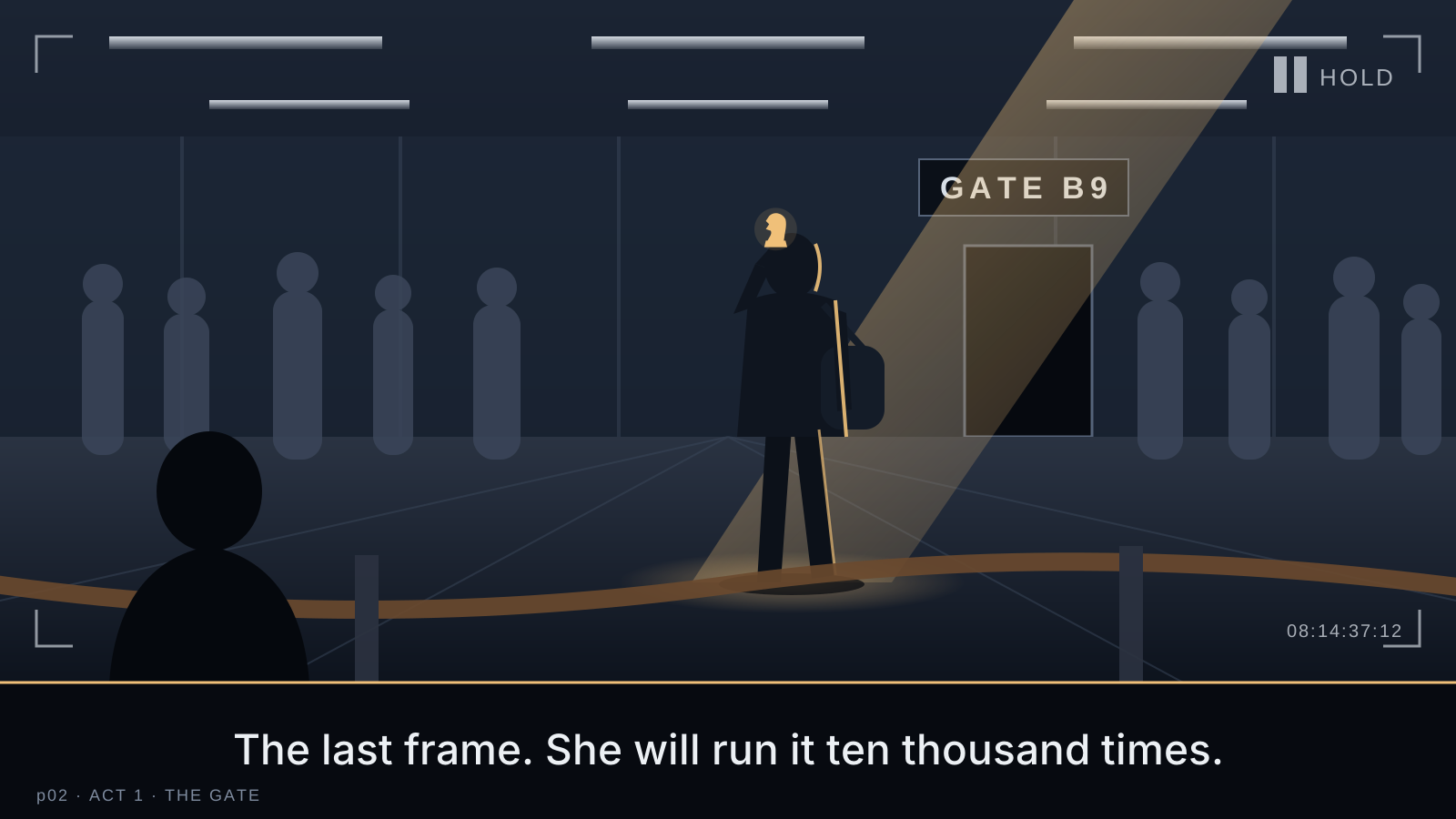




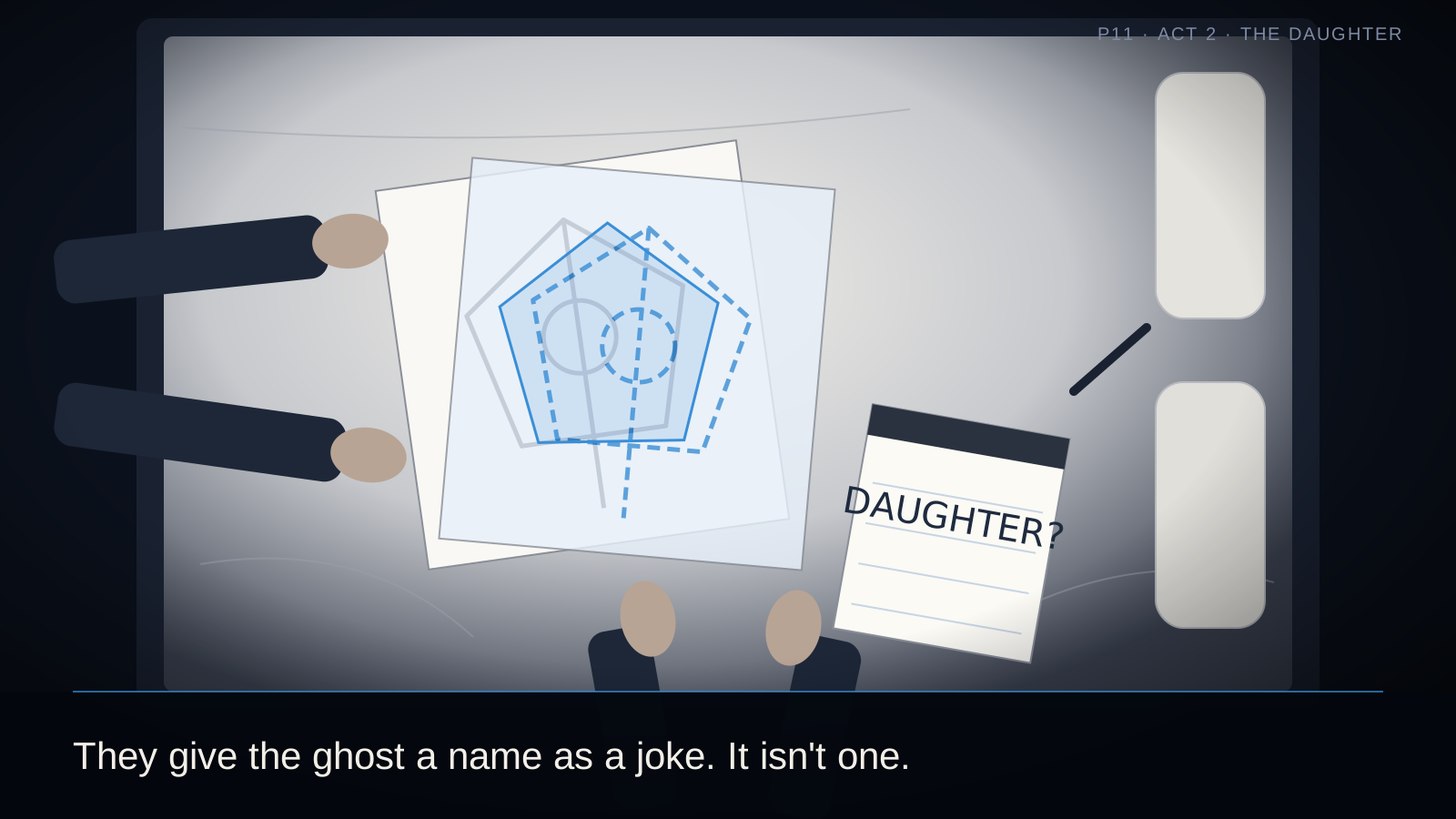







10 — The 22: Nos. 1 to 6
- Every person here is fictional. The Academy (renamable), Headmaster's Homecoming, its gala, its trustees, its guests and the contracted security firm are all invented. The party in the boathouse was the kids' own, and illegal; the boathouse belonged to a defunct private rowing club and is not Academy property. The Crossing was their dare, not an Academy tradition. No Academy official or employee had any part in the cover-up.
- Offices (the Fed, the Senate, the federal courts, the FISA Court, the White House) appear only as public structure. Every office holder here is an invented person.
- Working details (spouses, children, small facts not in canon) are marked working and can change without touching the plot.
- Ages: then (Year 0) → opening day (Year 28). The Vails die in Year 27; their cards give age at death.
How to read a card
- Then: age, family, why they were on campus that weekend, and exactly what they did that night.
- The years after: the road from the boathouse to power.
- Now: role, power, public face, private secret, what can break them.
- The Tower: their part in the deal and their penthouse floor.
- Through SUDDENDEATH: how the machine sees them, and how Ari sees them.
No. 1 — Sterling Vail · PRINCIPAL · kid
"No. 1. You held him under past the count."
Then (18)
- Family: Conrad and Eleanor Vail's elder son. Boston legal aristocracy on his father's side, old shipping money on his mother's. His little brother Julian, six, was asleep at the inn that weekend with a sitter.
- At the Academy: graduated in June, last spring's lacrosse captain, handsome in the way that makes teachers forgive things. Home for Homecoming from a gap year in Geneva. His father chaired the trustees; his mother chaired the gala. He had never once been told no on that campus, and he knew it.
- The party: his. He picked the condemned boathouse, had the fence cut, and supplied the drink and the pills to kids two and three years younger. He ran the Crossing: blindfolded, under the black water, while the room counted aloud.
- Why Declan: earlier that week Declan told him privately to stop selling to the underclassmen. Sterling laughed. At the party Declan said it again, in front of everyone: he was going up to the great hall to tell the adults who was supplying the party.
- What he did that night:
- Told the room Declan was "doing the Crossing first, so he understands what he's about to throw away."
- Walked him to the end of the dock. Gideon Strand tied the blindfold.
- Knelt with one hand on Declan's shoulder while Daisy Fenwick counted.
- Past thirty, leaned to the water and said something only Declan heard. (Working: "Now do you understand?")
- At forty-four he looked up at Fenwick. The count stopped.
- When Declan fought, he pushed down with both hands. Mallory held the arms; the others closed the way out.
- Owen Kilbride came through the door off the path and drove him off the dock with a shoulder.
- 1:00 a.m. His mother walked him out of the boathouse, through the kitchen of the inn, and into a car. His clothes were never seen again.
- 5:30 a.m. A private plane to Geneva. His name was gone from the gala guest list, as if he had never come home that weekend.
- He was not at the funeral. He sent flowers from Switzerland.
The years after
- Year 0 to 1: finishes the gap year in Geneva and stays on (working). The family story: "Sterling needed a change of air." Nobody at the Academy asks. He graduated in June; as far as its records go, he never came back.
- College: never plays again. Never goes near open water after dark.
- Year 7 (25): founds Vail Meridian Capital on his father's money. The first check comes with a note in Conrad's hand: "We don't look back." He burns the note and keeps the money.
- The rise: brilliant at one thing, reading when other people will panic. He bets on fear and wins. By forty, Vail Meridian is one of the largest hedge funds in the world.
- Year 19: stands best man at his little brother's wedding to Ari Halloran (working), at the Vail summer house. His toast is the funniest of the night. Ari's is funnier.
- His story to himself: "a dare gone wrong." He has said it in his head so often the words have worn smooth.
At death (45, Year 27)
- Role: founder and chief investment officer, Vail Meridian Capital.
- Power: tens of billions under management. Can move a currency or sink a company by talking about it at dinner.
- Public face: the loud, generous winner. Charity galas, a sports center named for his grandfather, a laugh you hear across the room. Touches people's backs when he wants them to forget he's taller.
- Family (working): divorced twice, no children. Uncle Sterling to Maeve and Dec: generous, loud, good with them. That's the part Ari can't forgive after Year 26.
- Private secret: he can't sleep with his hands under the covers. His first wife left partly over the nights he woke shouting, arms locked straight, pushing down on nothing.
- What could break him:
- Vane's film. He knows it exists; it was the family's insurance as much as Vane's.
- The fund: a decade of information that arrived "early" from friends in government. Nothing proved. Everything a regulator would love.
- His father: the seed money, the plane, the erased name. If one Vail goes, they all go.
The Tower
- Role: lead equity financier. Vail Meridian wrote the first and biggest equity check and talked the others in behind it.
- Penthouse: Floor 249. One of the four top floors Ari left open for the names she didn't have. Conrad took them as part payment and gave this one to his son. The guilty chose their own floors. She didn't see it until Year 26.
- Opening day: dark.
Through SUDDENDEATH
- How the machine sees him: filed with the hedge funds under "private actors who move markets." Brannock reads it for leverage on the President's donors.
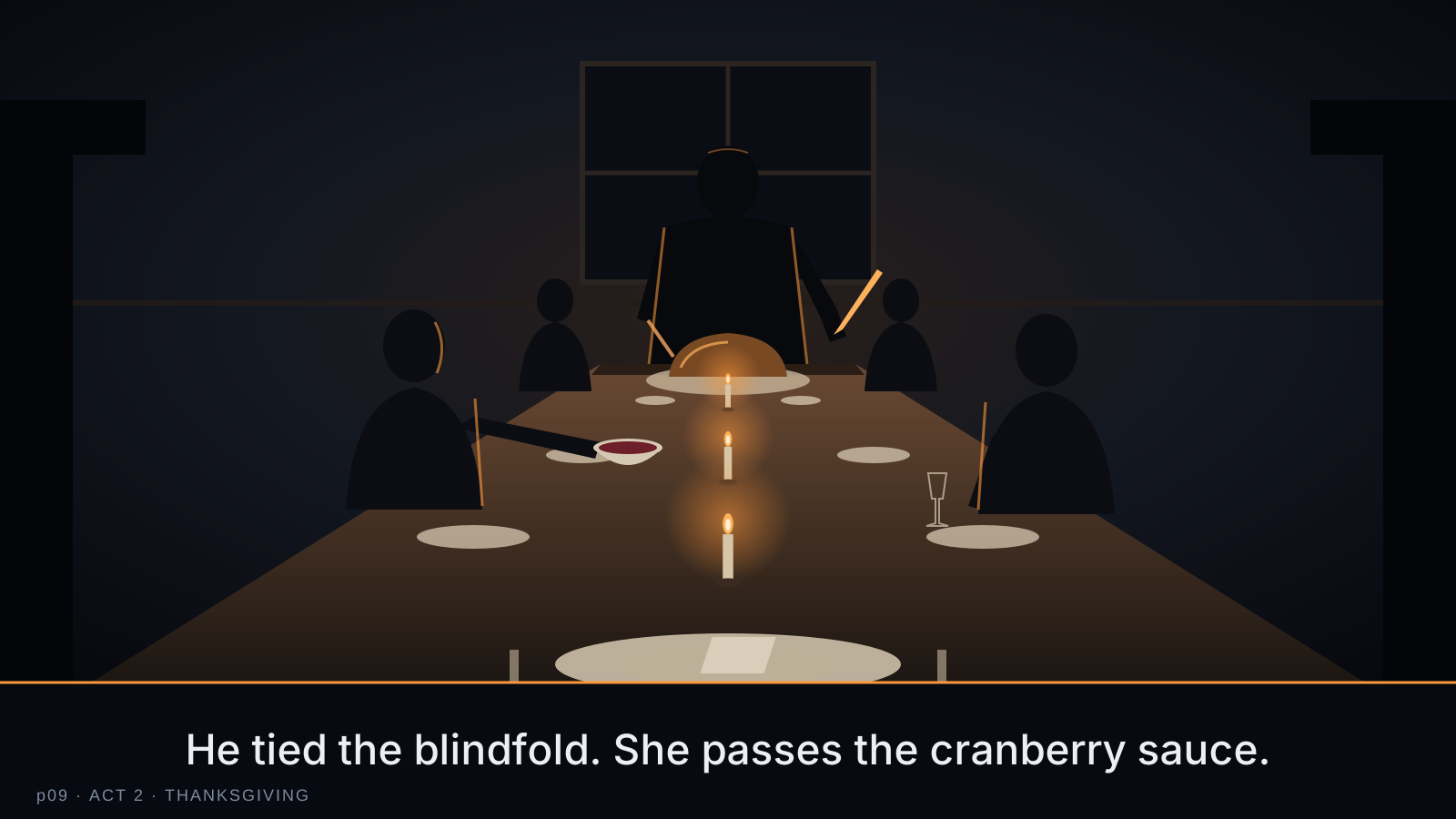
- How Ari sees him, before Year 26: family. Julian's big brother, loud at Thanksgiving, the uncle who brings the children too-expensive presents. She notices his trading shape (he sells into every panic within the hour) and makes a joke of it at Christmas Eve: "Sterling doesn't buy low. He buys other people's nerve, wholesale." The table laughs. Sterling laughs loudest.
- Her one blind spot: she pointed the most powerful surveillance machine ever built at every table in the world except her own.
- After Year 26: she watches his hands at Sunday dinner. A year of passing him the bread.
The answer (canon, Year 27)
- The summer house, late summer. The family learns she knows and plans her accident. Julian kills his father, mother and older brother to protect her and the children. Off-page; we stay with the aftermath.
- The official story: Sterling, Conrad and Eleanor are lost when the family boat goes down in fog off the point. She builds it before sunrise.
- What she lost: one year building his ending, his hands on the glass in front of the world. Julian took it from her in one night and gave her the children's lives instead. She never decides which was the better trade.
No. 2 — Conrad Vail · ORCHESTRATOR · adult
"No. 2. You decided the story before you decided anything else."
Then (44)
- Family: Boston legal aristocracy, third generation at the same firm. Married to Eleanor (née Thayer, No. 15). Two sons: Sterling, 18, and Julian, 6.
- Who he was: a Boston lawyer and fixer, not a trial lawyer: the man you call before you call a lawyer. Chair of the Academy's trustees (an invented board). Patrick Halloran's best friend since their first week at Stanford. Declan's godfather.
- Why he was on campus: Headmaster's Homecoming. He chaired the trustees, Eleanor chaired the gala, and he gave the dedication toast at dinner.
- What he did that night:
- 11:50 p.m. Brannock's call reaches him at the trustees' table. He listens, gives his first orders (call 911 now; the boy slipped; everyone else into the loft, silent), and finishes the sentence he was saying to the Headmaster before he stands.
- Midnight. Calls Harriet Kessler in Boston: "Bring a pen."
- 12:15 a.m. At the boathouse with Archer Penhale. Looks at his godson. Looks at his son. Decides the story before he decides anything else. Penhale takes the kids' phones.
- 12:40 a.m. Has Desmond Hale pull the boathouse path from the night's security logs.
- 1:00 a.m. Sends Sterling out with Eleanor.
- 1:41 a.m. THE FIRST CALL. Alone at the trustees' table in the emptied great hall, calls Patrick's Washington line and tells him everything: Declan is dead, Sterling did it, nothing can undo it. "Help me save the son I still have." Patrick is quiet a long time. Then: "Do what you have to. I'll handle my end."
- By sunrise: thirteen children with one story, the logs clean, the boathouse scrubbed, his son in the air over the Atlantic and his son's name off the guest list.
- Within 48 hours: his firm reaches every family with a child in that boathouse, as a "friend of the families." Kilbride is blamed, threatened and paid; the Rowans' debts disappear. Agreements attached.
The years after
- The day after: at the Halloran house in Boston "to help with the press." He holds Cate up in the hallway. At the grave he weeps, really weeps, for the boy he held at the font. Ari, five, reads that grief and it's true, and true grief is the one thing that hid guilt from her. She files him under family.
- Year 2: Patrick's biggest donor; chairs his finance committee. Patrick calls him "the best friend this family ever had." The political people call it coincidence.
- Years 7 to 18: places his people. Seed money for Vail Meridian. A word that puts Brannock on Patrick's Senate staff. A word for a judgeship (Kessler), a word for a regulator, Vail money behind Hale's firm.
- Year 17: his trust starts quietly buying the waterfront parcels that become the tower site. He thinks he spotted the land. He was shown it.
- Year 19: toasts his younger son's marriage to Patrick's daughter at the summer house. "Forty-five years ago I met a boy at Stanford who couldn't do laundry. Today our families are one." (working) Patrick cries. So does Conrad. Both are real.
- Year 21: groundbreaking. Takes the top four floors of the Crown as part payment: three for his family, 250 for the President, "for my oldest friend." Maeve is born that year.
- Year 23: holds his grandson at the christening and has to say the name aloud: Declan. His voice catches. Everyone in the church thinks it's love. It is, partly.
At death (71, Year 27)
- Role: chairman emeritus of his law firm; kingmaker; counsel to the developer; trustee of the land trust that holds the site.
- Power: the oldest and widest web of the 22. Money, judges, senators, editors. Most of the living names owe their first break to him, and he remembers every one.
- Public face: courtly, witty, generous to hospitals and libraries. A cane he doesn't need, carried across his knees like a scepter. Grandpa to Maeve and Dec, every Sunday.
- Private secret:
- The ledger. Fifty years, on paper, in his own hand: every favor given, every secret kept, who owes what. The night of the gala fills two pages.
- He knows about Milan. He has known about Giulia and Chiara Benedetti for years. He never needed that card: Patrick's 1:41 "yes" was a bigger one. The friendship and the leash are the same thing, and only Conrad knows it.
- What could break him:
- The ledger, if anyone ever reads it.
- Vane's film, his insurance as much as Vane's: his headlights on the boathouse wall, his wife's coat at the boathouse doors, his son's hands.
- The 1:41 call. One line on a carrier record that would end two men.
The Tower
- Role: counsel to the developer. His trust assembled and holds the land. Every lease, easement and title runs through his firm.
- Penthouse: Floor 248. He took the top four and placed his family there himself. The guilty chose their own floors.
- Opening day: dark. His gift, floor 250, is lit, and his best friend cuts the ribbon under it.
Through SUDDENDEATH
- How the machine sees him: filed under "donors with leverage over the administration." Brannock never pulls the file. Brannock is afraid of him.
- How Ari sees him, before Year 26: her father-in-law. The man who taught her chess in Maine when she was eight and let her win until she stopped letting him. She makes him laugh harder than anyone at the table; he says she's the only person who can.
- The one man who could have seen her coming: he has spent his life reading rooms. He sat across from her every Sunday for eight years and never once did, because he also saw only family.
- Year 26: Vane's film. Conrad's headlights on the boathouse wall at 12:15. The happiness ends that night. She keeps smiling at Sunday dinner, and keeps him laughing, for a year.
The answer (canon, Year 27)
- They learn she knows: the film has been seen, and he learns it. He does what he did at 12:15 that night: decides the story first. Her story is an accident. (Working: the plan is his; Sterling is the hands; Eleanor knows.)
- The summer house: Julian kills him, his mother and his brother to protect her and the children. Off-page.
- Before sunrise: she does to his death exactly what he did to her brother's. Decide the story first. A boat, fog, the point. She is very good at it. He taught everyone that night how it's done.
- The ledger (working): leaves the summer house in her bag before dawn. No one ever asks where it went.
- Patrick gives the eulogy. He loses his best friend and begins to wonder why. The 22nd name will land harder for it: he made the call for the family she married into.
No. 3 — Lyle Brannock · COVER-UP · kid · the Chief of Staff
"No. 3. He was still alive when you called Vail instead of 911."
Then (17)
- Family: a widowed mother, a pharmacist in a mill town in western Massachusetts. No father he talks about. At the Academy on a full scholarship the trustees' chair signed personally.
- At the Academy: a junior. Debate captain, student council, the boy who always knew which adult to ask. Sterling Vail's closest friend, in the way a scholarship kid is the closest friend of the trustees' son: useful, grateful, always there.
- Why he was there: Sterling's party. He helped cut the fence.
- What he did that night:
- Stood by the boat-bay door. Heard Declan say he'd tell the adults. Saw Sterling's face and guessed what came next. Said nothing.
- Watched the count stop. Didn't move.
- Kilbride was doing CPR on the boards and shouting at him to call an ambulance. Lyle took out his phone and called Conrad Vail. It reached the trustees' table at 11:50.
- He did it because he was 17, terrified and certain that adults fix things, and because the most powerful adult he knew was the father of the boy who did it.
- Relayed Conrad's first orders into the room (the story, then everyone into the loft, silent) and called 911 at 11:51 with Conrad still on the other line, repeating his words.
- Nineteen minutes before anyone called for help. They are his.
- Learned Kessler's story before four, room to room with the others, word for word.
The years after
- The story he tells himself: the boy was already gone when he made the call. Kilbride's CPR says otherwise. So does the medical examiner's estimate of time in the water, which no one has ever lined up with the call log.
- The lesson he learned: call the powerful man first. He builds a career on it.
- Year 10 (27): joins Senator Halloran's staff on Conrad's word.
- Year 12 (29): Patrick's Senate chief of staff. Patrick trusts him because Conrad vouched, and because he never gets tired.
- Year 16 (33): the tape. Off-page. See below.
- Year 18 (35): chairs Patrick's presidential campaign.
- Year 20 (37): White House Chief of Staff. In week one, on her word, he stands up SUDDENDEATH. He writes the name on the only paper copy of the charter, one word, all capitals.
Now (45)
- Role: White House Chief of Staff. Coordinates SUDDENDEATH for her: budget, authority, access, silence.
- Power: controls who reaches the President and what the President reads. Leans on a Fed governor, the IRS commissioner and a federal judge and watches each of them bend. Keeps Congress quiet with files.
- Family (working): divorced, no children. His mother is in a care home in western Massachusetts. He visits twice a year and pays for everything.
- What he believes about SUDDENDEATH: that she runs it to protect her father, and that he is the trusted hand that makes it possible. Half true. He has never asked the other half.
- The leash (Year 16): she arranged an encounter and a camera that recorded video but no sound. The footage is made to look as if he attacked her. Off-page, non-explicit, always. We see only what it does to him.
- Why no sound: with sound, the truth would be on the tape. Without it, only her version exists.
- He never tries to break free. He regrets it. He believes the moment was real and his own fault. He doesn't know he was manipulated; he thinks she's been merciful by not going public. He's too afraid of exposure to ever buck the status quo. The leash never needs pulling. His own guilt holds it.
- Private secret: he has also kept a message from Conrad for 28 years: "Remember the nineteen minutes. Remember who you called." He tells himself it's insurance. It's a second leash, and Conrad held the other end until Year 27.
- What he doesn't know: that she knows he's No. 3. He fears the tape every day. He has never once feared the boathouse.
- What could break him:
- The call log. His number calling Conrad's, nineteen minutes before anyone called for help. One line of carrier records.
- SUDDENDEATH itself. No signed order, no paper with the President's name. Only one tired sentence in the Oval Office: "Then fix it. I don't want to know how." Every page points at the Chief of Staff. She built it that way.
The Tower
- Role: the herder. He uses SUDDENDEATH files to pressure holdouts on the land, a stubborn bank committee, a planning board, all to "help a friend's project" he thinks of as the President's legacy. Every squeeze pulls another of the 22 into the deal. He never realizes what for.
- Penthouse: Floor 238, held through a blind trust. She ranked him there, in the middle of the Cover-up floors: one call, one cowardice, not the hands.
- How he got it: a deal sweetener from Strand, arranged through Conrad's firm, for clearing the last holdout. He has never set foot in it before opening day. It's the only thing he owns worth more than his salary.
- The irony she enjoys: the man who called Vail instead of 911 is herding his own people into her building, with her machine, on her word.
Through SUDDENDEATH
- How the machine sees him: the program files on its own coordinator. He has no idea.
- How Ari sees him:
- Not the villain. The tool. A frightened boy who made one call and then built a whole life out of making that call again.
- She steers him through Jonah Ellery's daily summary (working): what she wants him to see rises near the top of the page; what she wants left alone sinks.
- The dead man's switch: every door she used leads back to his office. He built the gun. His are the only fingerprints on it.
- Her humor is the other half of the leash. She's warm with him, funny, kind in public, the President's daughter who remembers his mother's birthday. He finds her kindness unbearable, and takes it as proof of her mercy.
- She won't let him destroy people who had nothing to do with the boathouse when she can quietly stop it. Some she can't. She carries those.
- The ticking risk: no rebellion, ever. The danger is a hunter (Nadia Kerrigan at Fort Meade, Callum Rees in London) reaching his office, and him folding out of fear, not defiance. Act 2 pressure point: she seals it before anyone gets close enough to frighten him.
- Opening day: at the President's elbow in the Crown lobby, phone in hand, running the day. The one man in the building who works for her and doesn't know why he's really there.
- Default (working): the tape never comes out. It doesn't need to. When the boathouse files open, the call log and the SUDDENDEATH charter carry his name on every page, and he understands, finally, that he was never afraid of the right thing.
- His last scene (working): he looks up from a phone that no longer answers and realizes there's no one left to call.
No. 4 — Marguerite "Daisy" Fenwick · PARTICIPANT · kid
"No. 4. You stopped counting at forty-four, and you knew exactly where you were."
Then (17)
- Family: a Philadelphia banking family; her mother a federal appeals lawyer, her father a partner at an old investment house, both on campus for the gala. Two younger brothers. Everyone has called her Daisy since birth; no one has ever said "Marguerite" out loud.
- At the Academy: a junior. Mathematics prize, perfect memory for numbers, a calm voice everyone trusted. That's why Sterling made her the timer for the Crossing.
- Why she was there: her friends were going, Sterling asked her personally, and her parents were dancing a quarter mile away.
- What she did that night:
- Counted the first three Crossings (Strand, Hartley, Brandt) to sixty, clear and steady.
- Began Declan's: "One. Two. Three."
- At forty-four, Sterling looked up at her. She stopped counting aloud. She understood the count was over.
- Kept counting in her head. Sixty came and went. She knew the number the whole time.
- The room went silent. That silence was the weapon. Without the count, no one could say how long it had been.
- When Conrad's orders came through Brannock, she and Rupert Mallory pulled Cordelia Rowan up the loft ladder, a hand over her mouth. Cordelia left the loft with the others at 1:15.
- Before four, room to room, she learned Kessler's story faster than anyone. She has always said she lost her place. She didn't.
The years after
- The habit she kept: she never counts aloud again. Not in a meeting, not to her children, not at a starting line.
- College and graduate school: economics. A doctorate on bank capital and the mathematics of failure.
- Year 13 (30): joins a regional Federal Reserve Bank as an economist.
- The rise: discipline and patience. She never argues; she waits, and the numbers make her case.
- Year 21 (38): confirmed as a Governor of the Federal Reserve Board and named Vice Chair for Supervision, the official who oversees the biggest banks. (An invented holder of the office.)
Now (45)
- Role: Governor, Federal Reserve Board; Vice Chair for Supervision.
- Power: decides how much capital the largest banks hold, which get relief and which get scrutiny. A word from her frees billions in lending or freezes it.
- Public face: modest, numerical, unflappable. Testifies in a navy suit and never raises her voice.
- Family (working): married to Graham Park, a pediatric surgeon. Twin daughters, 12. Chevy Chase.
- Private secret: her daughters swim. She has never once watched them race. She says it's work. It's the stopwatch.
- What could break her:
- The capital relief. In Year 21 she approved relief for Archer Penhale's bank, the bank whose chair took her phone at 12:15 that night and handed her the story. The relief freed the construction loan. There is a paper trail from her signature to his penthouse and hers.
- Vane's film carries her voice. "Forty-one. Forty-two. Forty-three. Forty-four." Then nothing.
The Tower
- Role: approved the capital relief for Penhale's bank that freed the construction loan. No signature, no money, no tower.
- Penthouse: Floor 245. Ranked high: her silence was a hand on him too.
- How she got it: bought "at market" through a family trust, from a Strand sales office that offered her a price no one else was offered. She told herself it was luck. The ethics lawyers were never told.
Through SUDDENDEATH
- How the machine sees her: "officials with leverage over the economy." Brannock leans on her once, in Year 21, when the relief stalls. She bends in four days.
- How Ari sees her:
- The woman who made silence into a weapon, now paid to keep the banks honest.
- Ari listens to her testimony and notices she never says a number above forty-three aloud. She rounds. Every time.
- Her file is clean except for one thing, and Ari leaves that one thing exactly where Brannock will find it, so he'll use it, so the relief will happen, so she'll be bound to the tower.
The answer (working)
- Opening day: on 245 with her husband, a glass of champagne she doesn't drink.
- What follows (working): the relief decision and the trail to Penhale's bank go to the Senate committee that confirmed her and to the Fed's inspector general. She resigns before the end of the day. Her statement says she "lost count." No one believes it.
- Her last scene (working): home that night, her daughters in the kitchen. They've heard the film. She counts, out loud for the first time in 28 years, to sixty. They wait for her to finish. Then they leave the room.
No. 5 — Bennett Thorpe · PARTICIPANT · kid
"No. 5. You brought him to the boathouse, and you knew why."
Then (16)
- Family: Boston Irish political family, a rung below the Hallorans and always aware of it. His father a state senator, on campus for the gala. His mother ran the family charity. An older sister.
- Declan: best friend since a Boston summer camp at twelve. Roommate at the Academy. Wore Declan's sweaters. Ate Thanksgiving pie in the Halloran kitchen and called Ari "kiddo."
- Why he was there: Sterling's party was the one everyone wanted in on. Earlier that week Sterling told him Declan was "going to be a problem" and needed to "understand a few things." Bring him, and you're in. Thorpe brought him.
- What he did that night:
- When Declan nearly didn't go, talked him into it: "Show your face, have one drink, laugh at Sterling. We'll leave by midnight."
- Walked him down from the dorm while the adults were sitting down to dinner, talking too much.
- Was standing next to him when Declan said, in front of everyone, that he was going up to tell the adults.
- When Declan fought, he stood at the edge with his hands at his sides and didn't move.
- At 2:30 he learned Kessler's story and gave it to the state police word for word.
- At the funeral he couldn't look at Ari, or her mother.
The years after
- The betrayal from inside the family's circle. The boy who slept ten feet from her brother.
- Years 0 to 2: keeps visiting the Halloran house, out of guilt, or habit, or because Conrad suggested it. Cate holds him like a second son. He lets her.
- Year 5 (21): Harvard, after a lost year he calls "a gap year" (working).
- The climb: law, a district attorney's office, the state legislature, always in Patrick's orbit, with Conrad opening doors.
- Year 20 (36): when Patrick leaves the Senate for the White House, Thorpe is appointed to Patrick's old seat (working). The governor's office calls it continuity. Cate calls it lovely.
- Year 21 (37): wins the special election.
Now (44)
- Role: US Senator from Massachusetts, in Patrick Halloran's old seat.
- Power: seats on the committees that hand out infrastructure money; a reliable vote for the President; a future people talk about.
- Public face: warm, grieving, loyal. In every profile he tells the story of his best friend who died young, "an accident that changed my life." He chokes up on cue, and the tears are real. That's the worst of it.
- Family (working): married to Annie, his college girlfriend. Three children. The oldest, 14, is Declan Thorpe. He named his son after the boy he walked to the water. When Ari names her own son Declan in Year 23, Thorpe sends the biggest gift at the christening and leaves before the cake.
- Private secret: he knew what Sterling meant to do before the party. Of the kids, he knows the most about why. He has never told his wife, his priest or himself out loud.
- What could break him:
- Vane's film shows him beside Declan, standing still. His career is built on the grief story.
- The transit grant, steered to the tower in Year 21, with a Strand penthouse at the end of it.
The Tower
- Role: won the federal grant for the tower's transit hub, the rail and ferry station under the Harbor tower that made the site work.
- Penthouse: Floor 243.
- How he got it: a "family friends" price from Strand, held in his wife's name. He told Annie it was an investment for the children.
- What he says at the opening: a line in his speech about Declan. He has rehearsed it in the mirror.
Through SUDDENDEATH
- How the machine sees him: "rivals at home," the tier Brannock never puts in writing. A possible challenger one day, a reliable vote today.
- How Ari sees him:
- The knife. Not a stranger. The boy who taught her to skip stones in Boston harbor and then took her brother to the water.
- She reads him easily; she always has. He has looked for her in every room for 28 years, the way people look for a bruise.
- She keeps him close in public. Hugs at Christmas parties. Lets him call her kiddo. Makes him laugh until he forgets himself, then watches him fail to meet her eyes for one full second. Every time.
The answer (working)
- Opening day: he gives his line about Declan in the Crown lobby, ten feet from her, and it's the best he has ever delivered it.
- What follows (working): his file, with the grant and the penthouse, goes to the Senate Ethics Committee and the press of his own state. His grief story dies on air beside the film.
- His last scene (working): he finds Cate Halloran in a holding room with Matt Reyes on the door. He tries to say something. She looks at him for a long time. He has wanted for 28 years to be forgiven by her. She doesn't do it.
No. 6 — Harriet Kessler · COVER-UP · adult
"No. 6. You wrote the lie that night, word for word, and taught it to thirteen children."
Then (33)
- Family: a New York judicial family; her grandfather a state high-court judge, her father a federal prosecutor. An only child raised to argue.
- Who she was: senior associate at Conrad Vail's firm, his best drafter. Harvard Law, a federal clerkship, then Vail. The associate he called when a sentence had to hold.
- Why she came: she wasn't at the gala. She was asleep in Boston. At midnight Conrad called: "Bring a pen." She was on the road in ten minutes and on campus at 2:30, still in the coat she'd thrown over her pajamas.
- What she did that night:
- 2:30 a.m. Took Conrad's version down on the back of the gala's printed dinner menu (working), line by line:
- A few kids drank at the boathouse after the dance.
- Declan, drunk, wandered onto the dock alone.
- He slipped, struck his head and went into the water.
- A local boy working the catering found him and tried to save him.
- No dare. No Sterling. No party worth the name.
- Read it back to Conrad, word for word, and fixed the two phrases he didn't like.
- Taught it to thirteen children between 2:45 and 4:00, room to room at the inn and in the dorms, one at a time, the way you prep a witness: "If you don't remember, say you don't remember. Never add. Never improve it." Penhale stood at the door.
- The kids' statements to the state police matched because she had written all of them.
- She kept the menu. She has never told anyone, Conrad included.
- 2:30 a.m. Took Conrad's version down on the back of the gala's printed dinner menu (working), line by line:
The years after
- Year 1 (34): made partner. Nobody at the firm asks why the youngest partner in its history got the vote early.
- Year 3 (36): leaves for the US Attorney's office (working). Airtight briefs, hard sentences.
- Year 18 (51): confirmed as a US District Judge. Conrad's firm does nothing visible. Nothing visible is required.
- Year 19: draws the land-title and eminent-domain case for the tower site. She doesn't recuse. On paper she has no relationship with the parties; she left the firm sixteen years ago.
- Year 20: rules for the land trust and clears the site.
- Year 21 (54): designated to the Foreign Intelligence Surveillance Court, the court that approves certain government surveillance under law. (An invented judge on a real court's public structure.)
Now (61)
- Role: US District Judge; also sitting on the FISA Court.
- Power: lifetime tenure. The last word on property, contracts and federal crimes in her courthouse; one of a handful of judges who approve lawful surveillance requests.
- Public face: the incorruptible judge. Precise, unsmiling, admired by both parties. On the short lists for an appeals court.
- Family (working): married to Daniel Okafor, a law professor. One son, 26, an investigative reporter in Boston. She discouraged it.
- Private secret:
- She still has the menu. The story in her own handwriting, Conrad's two corrections in the margin, the gala's crest on the other side. It's in a safe-deposit box. She has never been able to burn it. It's the best thing she ever wrote.
- Every opinion she writes, she drafts once in longhand first. The habit started that night.
- What could break her:
- The site case. She ruled on land held by a trust controlled by the man who dictated a story to her over a dead boy. That alone ends a judicial career.
- The penthouse on top of it.
- The menu, if it ever leaves the box: the cover-up in her handwriting.
The Tower
- Role: presided over the land-title and eminent-domain case that cleared the site. No ruling, no tower.
- Penthouse: Floor 241.
- How she got it: "bought" two years after her ruling, through a cousin's company, at a price a Strand sales manager had been told to offer. The gap between ruling and purchase was her idea. It wasn't long enough.
Through SUDDENDEATH
- How the machine sees her: "officials with leverage over the economy." Brannock leans on her once, in Year 20, when the land case drifts. He never knows she was always going to rule for the trust.
- The irony: SUDDENDEATH exists to avoid courts like hers. The judge who approves lawful surveillance is a target of the unlawful kind and has no idea.
- How Ari sees her:
- The author. At the funeral, every child from the Academy said the same sentences in the same order. Ari, five, noticed. Somebody wrote that. It took her nine years to find out who. Kessler was on her list by Year 14.
- Ari reads her published opinions as a body of work and finds the menu's rhythm: short sentences, no adjectives, nothing that can be cross-examined.
- Ari finds the safe-deposit box. She doesn't open it. She lets it be found at the right time by the right people.
The answer (working)
- Opening day: on 241, reading the opening-day program the way she reads a brief, looking for the flaw.
- What follows (working): her site ruling and the penthouse go to her circuit's judicial council and the House committee that handles impeachments of federal judges. The menu comes out of the box under a warrant from a court outside her circuit. Her own words read on air: "Declan, drunk, wandered onto the dock alone."
- Her last scene (working): she resigns in a letter drafted once in longhand first. Her son, the reporter, is the one who breaks the story of the menu. She taught him that you never add and never improve it. He doesn't.
Cross-links among Nos. 1 to 6
- The Vails: Nos. 1 and 2 here; Eleanor (No. 15) in
12; Patrick (No. 22, the sign-off) in13. Father, son, mother, and the best friend who said yes. - The dock: Thorpe (brought him) → Strand (blindfold) → Sterling (hands) → Fenwick (the count stops on Sterling's look) → Mallory (the arms).
- The night's chain: Brannock (the call, 11:50) → Conrad (the story, 12:15) → Patrick (the yes, 1:41) → Kessler (the pen, 2:30) → Thorpe and Fenwick (the recital to the state police).
- The chain of the tower: Conrad (the land) → Kessler (clears the site) → Fenwick (frees the loan) → Sterling (the equity) → Thorpe (the transit hub) → Brannock (herds the holdouts).
- Who knows what:
- Knows everything: Conrad, Sterling (and Eleanor, and Patrick's one end of it). Penhale knows the whole night but not whom Conrad called at 1:41.
- Knows their piece and guesses the rest: Brannock, Kessler, Fenwick, Thorpe. Thorpe knows the most about why; Kessler knows the exact words.
- At her own table: four of these six sat at Ari's Christmas Eve for years: Conrad, Sterling, Thorpe and, from Year 12, her father's chief of staff. The answer was passing her the gravy.
- A dare gone wrong, or meant? Every card holds under either reading. If meant, Sterling's words at the water become a verdict, not an excess.
- The Sterling crack: use the "never on the water after dark" detail as the thing that makes Patrick wonder, or drop it?
- The Vail killings: whose plan the accident was (Conrad, working), and how much of the summer house stays off-page (default: all of it but the aftermath).
- The 18 living names: every working "answer" here is exposure and ruin. Darker or quieter versions can replace those bullets without touching the night.
- Family details marked working are free to change. Fenwick's husband was renamed Graham Park to keep "Julian" for Julian Vail.