







08 — The Hunters
- Every person in this file is fictional. Agencies appear only as their public structure.
Why there are two
SUDDENDEATH is built to be invisible to its own country and to its closest ally. So the story needs one honest person on each side of the Atlantic who sees it anyway.
- Nadia Kerrigan sees it from inside the machine (NSA, Year 23).
- Callum Rees sees it from outside the machine (Parliament's oversight, Year 24).
- Neither ever sees her. Each gets close enough to feel her, and that is the horror of it.
- Both are steered away. Neither is destroyed outright. Both pay anyway.
- Where they get close now: not to her heart (that's Julian's) but to the two places the machine can break:
- The Chief of Staff's fear. Brannock will never rebel. He might panic.
- The killings' cover-up. The one night she does what the adults did, and the one night her work has to be perfect with no time to make it so.
The rule for both hunters: they are smart, decent and right. They lose because she is better, not because they are foolish.
1. Nadia Kerrigan — the US hunter
Who she is
- Age: 34 in Year 23. Grew up in Scranton, Pennsylvania. Father a postal carrier, mother a school nurse.
- Path: state university on a math scholarship, then a master's in statistics. Recruited to NSA at 24.
- Job: analyst in the Operations directorate at Fort Meade. Her specialty is pattern-of-life work: noticing when the shape of events is wrong, long before anyone can say why.
- Manner: quiet, dry, exact. Eats lunch at her desk. Keeps a paper notebook because she trusts her own handwriting more than any system.
- Private life: divorced, no kids. Runs at 5 a.m. Sings in a church choir she rarely has time for. Loves crossword puzzles and hates being told what the answer is.
- Her flaw: she cannot leave a loose thread alone, even when pulling it will cost her.
- Her strength: she does not care who is powerful. She cares whether the numbers add up.
What she notices (Year 23)
SUDDENDEATH never appears in her systems by name. It is off-books. But its fingerprints land on her desk as luck.
- Over 18 months, a run of White House wins lines up too neatly: a foreign leader folds before a summit, a billionaire drops a lawsuit, a holdout senator flips.
- Each win is explained as good politics. Each one, alone, is believable.
- Nadia charts them. Put together, they share a shape: every win follows, within days, a request routed through channels she can see only the edges of.
- The requests are tasked under legitimate-looking authorities, but the taskings don't match any program she can find. They are filed in places that don't connect.
- Then she finds something stranger: a second shape inside the first. Some of the "luck" doesn't help the White House at all. It helps a handful of private people: Vail Meridian Capital, a defense CEO (Hale), a cloud company (Lanternwell), a Boston law firm (Conrad Vail's).
- Without knowing it, she has seen the 22 begin to tighten around the tower. And without knowing it, she has written the President's daughter's married name twice on one page.
Nadia's note in her paper notebook: "Somebody is reading the whole world, and somebody else is reading over their shoulder."
How close she gets: the Chief of Staff's fear
- Closest point: she works out there are two hands on the program: the one everyone serves (the Chief of Staff's office), and a quieter one that edits what he sees.
- She writes a nine-page memo for her branch chief. She never names Brannock. She never names anyone. She just says the shape is real and asks for the authority to look.
- The flag reaches the West Wing. Brannock reads a summary line, "possible second principal behind tasking routed via the Chief of Staff," and for one night he believes it's about the tape.
- This is the danger. Brannock never fears the program. He fears exposure. A man that frightened might do the one thing she can't control: talk first, to get ahead of it. He drafts a resignation letter at 2 a.m. He never sends it, but he writes it.
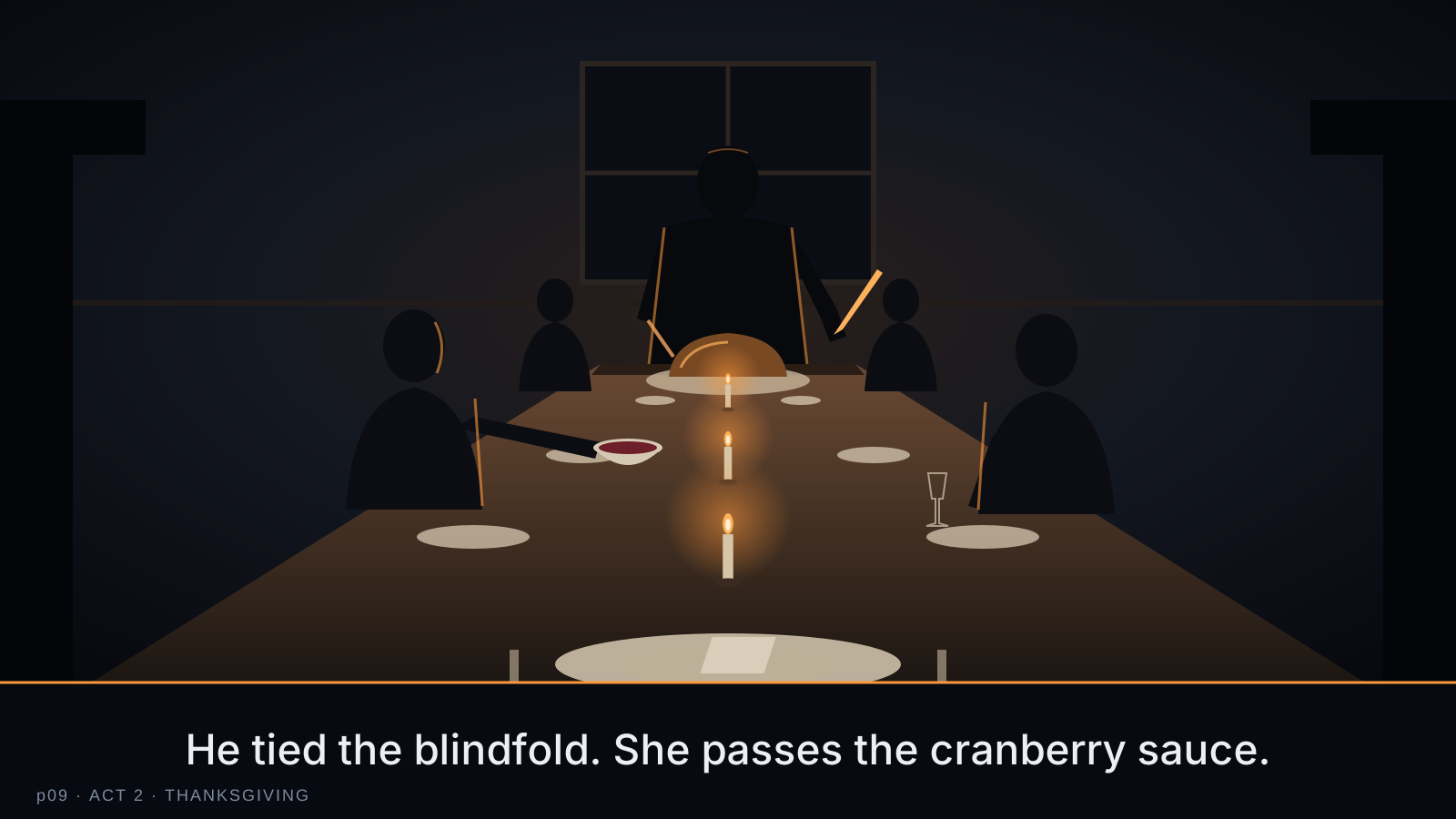
- Ari reads him in the morning (a Sunday lunch at the Residence, the children under the table). One look and she knows he hasn't slept and knows why. She makes him laugh twice before dessert. By coffee he's decided it's nothing.
- The near-touch: in one meeting, Nadia sits ten feet from Ari, who is visiting Fort Meade on a First Family tour a few months after Dec is born. Nadia notices nothing except a young mother who makes the whole briefing room laugh with one dry line about the coffee, asks one oddly good question about base rates, and then goes back to looking bored.
- That night Nadia writes the question down. She doesn't know why.
How Ari steers her away
Ari never touches Nadia directly. She changes the shape so the pattern points somewhere else.
- She gives Nadia a better answer. Ari lets a smaller, real scandal surface: a contractor quietly selling analysis to a private fund. It explains part of the pattern. It's true. Nadia found it, so Nadia believes it.
- She lets the system reward her. Nadia's memo, reworked around the contractor, is praised. She gets a commendation. The praise does what threats couldn't: it closes the case in her own mind for a while.
- She lets Brannock's fear do the rest. She never orders him. She only lets him see that the memo is "about a contractor." Relief makes him helpful: he arranges, through ordinary channels, for Nadia to be promoted sideways to a good job, a new team, a different problem. He thinks he protected the program. He thinks he protected himself. He did her work for her, again, and never feared the right thing.
- She seals the last crack. The paper notebook. Ari can't reach it, so she makes it irrelevant: the pattern that was in it stops happening. Over the next year the "luck" changes rhythm. Nadia's old chart no longer predicts anything.
The second near-miss: the night of the boat (Year 27)
- Four years on, on her new team, Nadia still runs her old chart once a month, out of habit, like checking a locked door.
- One morning in late summer, the news: Conrad, Eleanor and Sterling Vail lost when their boat went down in fog off the point. The President's best friend. His daughter's in-laws. The tower's counsel and its lead financier.
- The near-miss has nothing to do with the program. Out of an analyst's habit she pulls the public weather-buoy record off that stretch of the Maine coast. Visibility at eleven: eight miles. The fog doesn't roll in until after two. The official story has the Vails sailing after dinner.
- Nadia writes the date in the notebook beside the old names: Vail, Vail Meridian. She is closer to the truth than anyone alive.
- Why she stops: the fog was real, and on that coast it comes in fast. The Coast Guard report is clean. Her last memo cost a protégé his job. And on TV, the Vails' daughter-in-law stands at the funeral holding a little boy named Declan, and Nadia cannot make herself believe a mother did anything that night but grieve.
- The irony she never learns: she was right, and the thing that stopped her was the same thing that hid the Vails from Ari at five: grief that looked real because it was.
What it costs Nadia
- Her certainty. She was right, and the world told her she was wrong in the kindest possible way. She starts to doubt the one thing she always trusted: her eye for a shape.
- Her old team. The sideways move takes her away from the people who believed her. One of them, a young analyst she mentored, is quietly let go in the contractor clean-up. Nadia blames herself.
- Her sleep. She keeps the notebook in a drawer at home. Some nights she takes it out and reads her own note, and the date of the boat. She knows she missed something.
- What she never learns: that the funny young mother with the base-rates question is the reason her life went sideways.
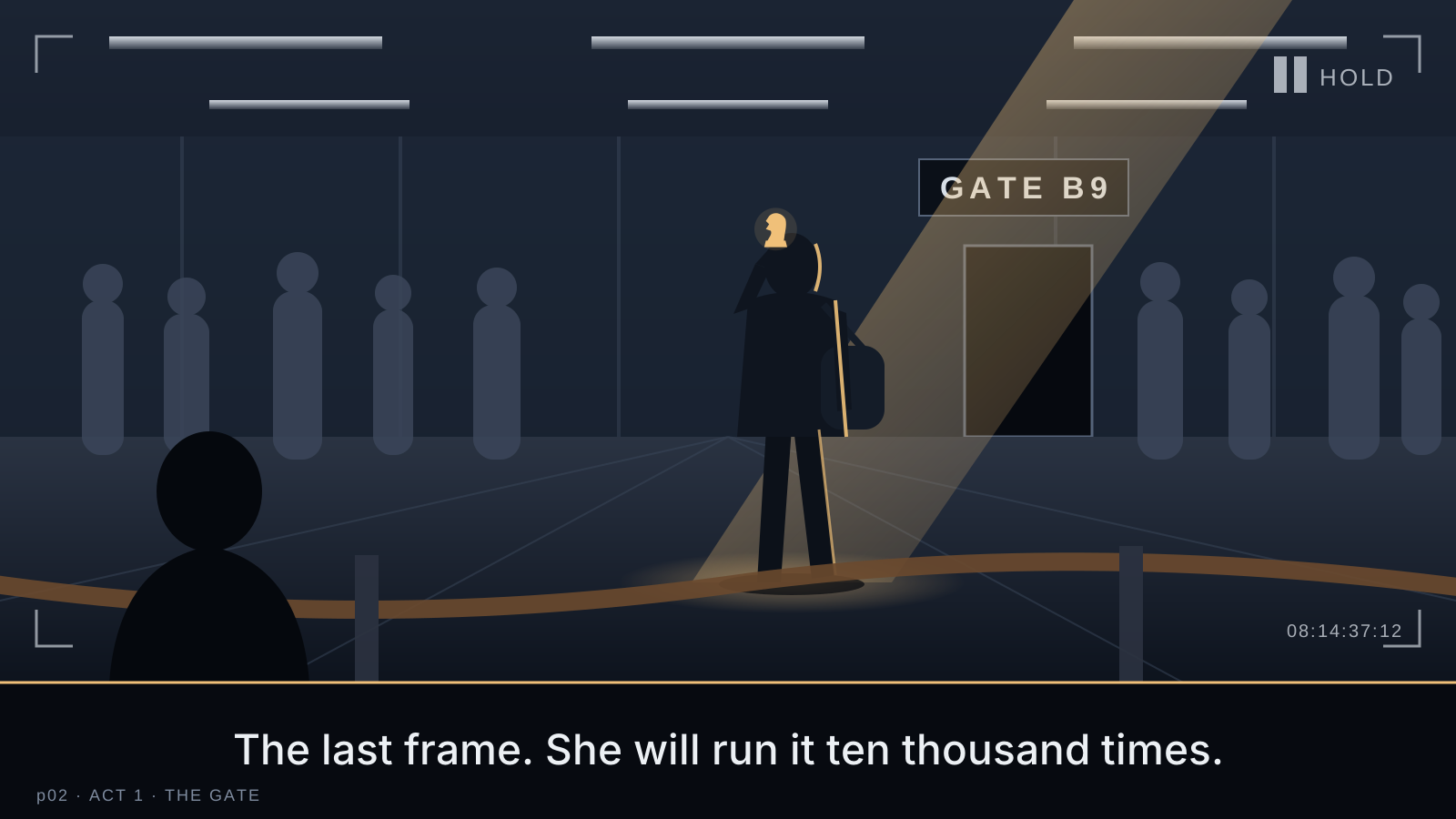
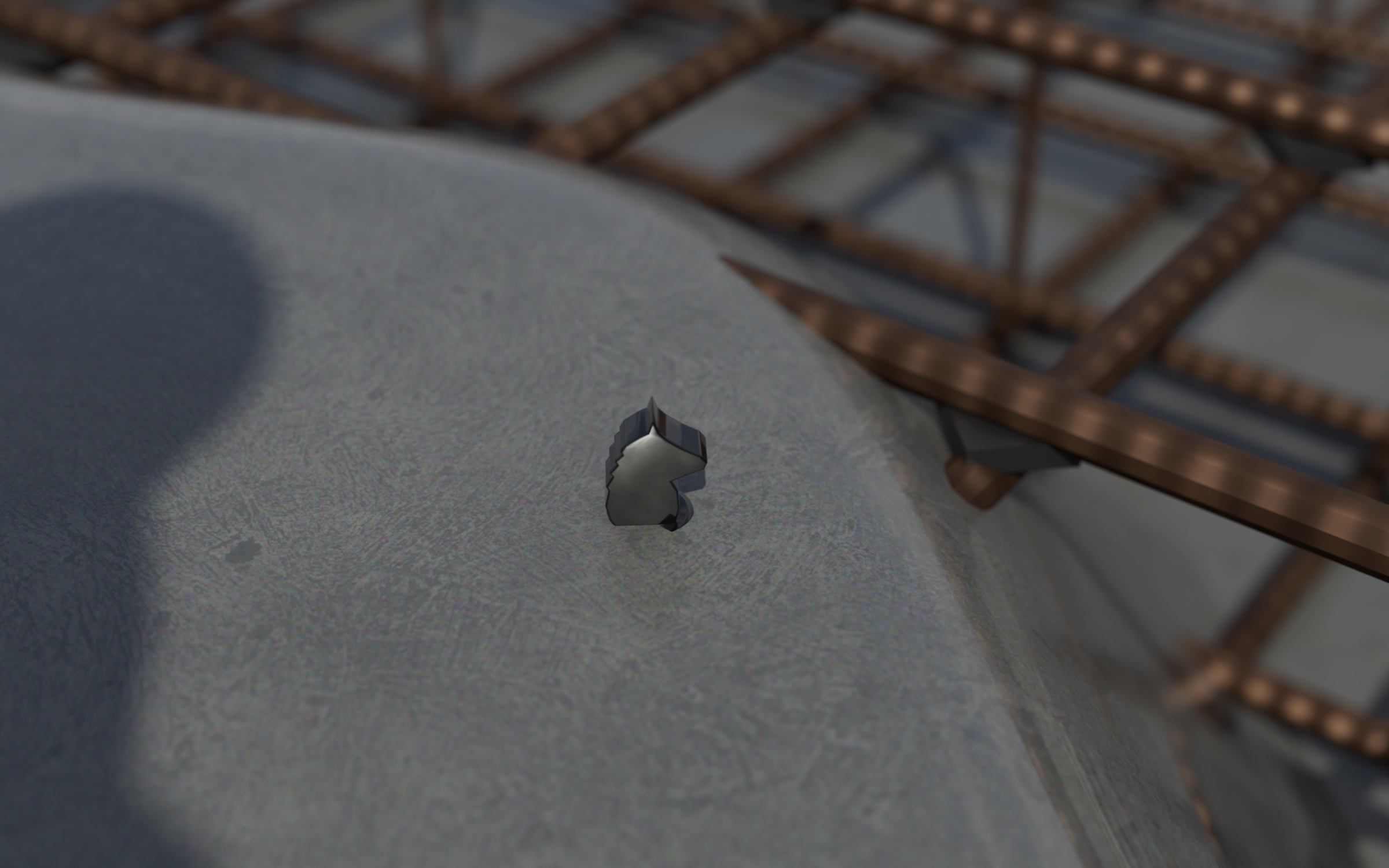
- Where she ends: on opening day, she is on the plaza with a press credential she never requested, beside the man she has only ever met on a secure line. The Crown's top floors are dark and nobody on air says why. She looks at floors 247–249, then at the President under floor 250, and recognizes the shape at once. That night, in the Harbor press center, she and Callum find two press passes, a phone and a chess knight. She tells no one. She closes the notebook and, for the first time in five years, sleeps.
2. Callum Rees — the UK hunter
Who he is
- Age: 37 in Year 24. Born in Swansea. Welsh, grammar-school, first in his family at university (history at Durham).
- Path: ten years as an MI5 analyst, then moved across to Parliament as a clerk to the Intelligence and Security Committee (the ISC).
- What the ISC is (public structure): the committee of MPs and peers that oversees the UK intelligence agencies (MI5, MI6 and GCHQ) and reports to Parliament. Its staff are civil servants, not spies. A clerk prepares inquiries, reads the evidence, and writes the drafts the members sign.
- Why he left MI5: he believed in oversight. He wanted to be the man who checks the work, not the man who does it.
- Manner: warm, funny, a beautiful speaker who never shows off. Reads poetry on the Tube. Laughs at himself first.
- Private life: single. A long relationship ended because he worked every weekend. Plays the piano badly in a flat in Kennington. Rings his mother in Swansea every Sunday.
- His flaw: he wants to believe people are better than they are. He extends trust one step too far.
- His strength: he listens. People tell him things they've never told anyone, and he remembers all of it.
What he notices (Year 24)
- Under Five Eyes, the UK and US share intelligence through agreed channels, with rules about who may read what.
- During a routine ISC inquiry, Callum reviews how GCHQ reporting is shared with American partners.
- He finds that some GCHQ product is being read by someone outside the agreed chain. The access looks legitimate on paper but leads to no office he can name, only to a request stamp from the White House Chief of Staff (an invented holder of the office)'s office that no one in London can explain.
- Worse, the reports being read are not about terrorism or hostile states. They are about British people: City financiers, an insurer, a peer close to the Palace.
- One name keeps returning: Baron Mallory of Wrenhaven (No. 11). Callum doesn't know why an American program would care about a London insurer.
- He also finds an echo of an old Palace embarrassment, Princess Seraphina of Carrow, whose life fell apart years ago at a Swiss school for reasons no one ever explained. Her file was read too. Callum can't see why.
Callum's draft line, cut by his chair before it reached the committee: "We are not the only ones reading our own reports, and we do not know who the other reader is."
How close he gets
Callum gets much closer than Nadia, because he gets close to her, and then to Brannock.
- He traces the Mallory reads to American interest in a single project: a waterfront tower, three spires, the tallest building on Earth. Mallory's firm is insuring it.
- He goes to Washington as part of an ISC delegation, a normal trip with normal meetings.
- At a reception at the British Ambassador's residence, he meets the President's daughter. Married, two small children at home, sharp and unremarkable on purpose. She is also the funniest person he has met in ten years. They talk about Welsh poetry for forty minutes and he laughs harder than he has since Durham.
- He mentions, lightly, that he gave a lecture at Oxford the year she was there. She remembers. She remembers everything.
- A friendship, not an affair. Over the next year they meet again: a conference in London, a dinner in Boston with Julian at the table (Julian likes him at once), a long walk by the river in Cambridge. He never connects her to his inquiry. He just likes her more than he's liked anyone in years, and knows exactly where the line is, and keeps to it.
- Closest point, part one (Year 25): Brannock. On a second delegation, Callum gets twenty minutes with the Chief of Staff and asks, courteously, why the Chief of Staff's office stamps requests for GCHQ product on a London insurer. Brannock's hands shake on his coffee cup. Callum, a trained listener, reads it as a man hiding a program. It's a man hiding a tape. Either way, Callum leaves sure he's touched the nerve.
- Closest point, part two (Year 25): her. Weeks later, on the Cambridge walk, he asks her, as a friend, what she knows about the tower and why Brannock might be frightened of it. He's asking about Mallory. She hears a man who is one question away from the truth, and who has just found the one beam in the machine that could crack.
How Ari steers him away
Ari steers Callum with the truth wherever possible, because lies would show in her face and he reads faces too. Not as well as she does, but well.
- She answers with a joke, and a true thing. On the walk: "Lyle is frightened of everything. He once apologised to a revolving door." Callum laughs. Then, quietly: Brannock's had a hard year. True. It sounds like a friend protecting a colleague's privacy. Callum, who is decent, stops pushing on a frightened man.
- She calms Brannock before Callum's follow-up arrives. Brannock tells her, sweating, that a British clerk asked about the insurer. She tells him it's a Five Eyes housekeeping inquiry and it'll find a contractor. He believes her because he needs to. His follow-up reply to the ISC is dull, correct and complete. Fear made him careful; she made sure it didn't make him honest.
- She lets the inquiry find a real leak. A genuine, smaller breach: an American contractor with over-broad access. The ISC reports it. The fix is made. It's a good report. Callum wrote it.
- She lets his own chair close it. The ISC chair, the invented Dame Imogen Askew MP, is under pressure from Downing Street not to embarrass the Americans. Ari didn't make that pressure; she only made sure it arrived on the right day.
- She takes Mallory off his board. Mallory's firm moves the tower insurance into a structure that makes it look routine, the kind of deal a dozen London insurers do every year. Mallory thinks it's his lawyers' idea.
- She takes Seraphina off it entirely. Whatever was in that file stops being readable by anyone. Callum's last thread to her own past goes dark.
The end of the friendship (Year 26)
- Autumn, Year 26: the search lands. She watches Vane's film in Zurich and sees Sterling's hands, Conrad's headlights, Eleanor's coat. The happiness ends that night.
- Within the week she ends the friendship. Not because Callum knows anything, but because from now on she can't afford one person outside the family who reads faces for a living and likes her enough to look closely.
- She does it in person, in Boston, in the rain. Kind, final and impossible to argue with: "I can't be the person you think I am." The most honest sentence she says to anyone that year.
- He spends the next two years trying to understand what he did wrong.
The second near-miss: the claim (Year 27)
- Late summer, Year 27. Callum, still reading Mallory traffic for a follow-up inquiry, sees the news: the President's best friend and his family lost at sea. Ari's in-laws. He writes her a condolence note by hand. She reads it twice and keeps it.
- Then a line crosses his desk: Mallory's firm has paid the key-person claims on Conrad and Sterling Vail (the tower's counsel and its lead financier) in nine days, with no loss adjuster's questions. Nine days, for a sum that size, is unheard of.
- The old Callum would have pulled it. He knows exactly how. He has the authority to ask.
- He doesn't. His committee closed the last door he knew was open. His faith in oversight is gone. And the claim is about her family's grief, and he cannot bring himself to turn her dead in-laws into a file.
- The irony: the one time in his career Callum Rees stopped pulling a thread, it was the thread that led to the night she became what she hunted. She didn't steer him off it. His decency and his disillusion did it for her, and she never had to lift a finger.
What it costs Callum
- His faith in oversight. He watched his committee close a door he knew was still open. He stays at the ISC, but the belief that brought him there is gone. The unpulled claim proves it to him.
- His career, quietly. He is passed over for the senior clerk's post. Nobody says why. Ari didn't arrange it; Downing Street's irritation did. She knew it would happen and let it.
- Her. The best friend he made in his thirties, gone without a reason he can live with.
- What he never fully learns: whether he was a friend or a file. On opening day he is on the plaza with a press credential he never requested, beside Nadia Kerrigan. When the screens show the Crown with its top floors dark, and a camera finds Mallory among the guests, Callum puts it together in about four seconds: the tower, the Mallory reads, the frightened Chief of Staff, the nine-day claim, the American he talked poetry with. He finally understands she was the other reader. He never understands that the friendship was real anyway, the one place outside her marriage where her laughter wasn't entirely working for her.
3. Where the hunters get close: the two weak beams
The Chief of Staff's fear
- What Brannock fears: exposure of the tape. What he never fears: the boathouse, or her. He doesn't know she knows he's No. 3.
- Why that's dangerous: he will never rebel, but a frightened man under a hunter's question might confess something to get ahead of it. Whatever he confesses, the program comes with it.
- Both hunters reach him: Nadia by paper (the memo flag, Year 23), Callum in person (the twenty minutes and the coffee cup, Year 25).
- Both times he misreads the threat as the tape, panics privately, and then does exactly what helps her: promotes Nadia sideways; answers Callum with a dull, complete reply.
- Both times she seals it the same way: she reads him before he acts, gives him a harmless explanation, and makes him laugh. Relief is a stronger leash than the tape.
- Rule: no rebellion subplot, ever. The tension is whether fear makes him blurt, never whether he decides to fight.
The killings' cover-up
- The one night her work isn't planned. Every other move she makes was designed years ahead. The summer-house night (Year 27) is improvised in hours, before sunrise, the way the adults improvised hers.
- What each hunter touches: Nadia sees a weather buoy that says the fog came late. Callum sees a claim paid too fast. Neither sees the house, the boat or Julian.
- Why both let it go: grief. Nadia sees a mother at a funeral. Callum can't turn her family's loss into a file. The same thing that hid the Vails from Ari at five now hides Ari.
- What it means: she's never caught. Not because the cover-up is flawless (it isn't; two honest people each held a loose end) but because the cover-up works the way the adults' did: people decide not to look. Power means never facing consequences, and now that's true of her.
4. Side by side
| Nadia Kerrigan | Callum Rees | |
|---|---|---|
| Country / seat | US · NSA Operations, Fort Meade | UK · ISC clerk, Westminster (ex-MI5) |
| Year they notice | Year 23 (Ari is 28, Dec just born) | Year 24 (Ari is 29) |
| What tips them | The program's "luck" has a shape | GCHQ product read outside the agreed chain |
| Thread that leads near the 22 | Private wins for Vail Meridian, Hale, Lanternwell, Conrad Vail's firm | Baron Mallory (No. 11), and the old Seraphina file |
| Reaches Brannock | By memo flag; he drafts a resignation, never sends it | In person; his hands shake on the cup |
| Closest point | Sees two hands on the program | Asks Ari herself about the tower and Brannock |
| Steer | A true smaller scandal, a commendation, a sideways promotion via Brannock's relief | A joke, a true smaller leak, a chair under pressure, Mallory's deal made routine |
| Year 27 near-miss | A public weather buoy: the fog came hours after they sailed | The Vail claims paid in nine days |
| Why they let Year 27 go | Grief that looks real | Decency and lost faith |
| Cost | Certainty, a protégé's job, sleep | Faith in oversight, promotion, her friendship |
| On opening day | On the plaza; understands part of it first; the press center; tells no one; sleeps | On the plaza; understands in four seconds; the press center; never knows the friendship was real |
5. Craft notes for the writers
- Never let a hunter be stupid. Every wrong turn they take should be a turn a brilliant person would take, given what she let them see.
- She steers with truth where she can. Real smaller scandals, real pressures, real promotions. Her lies are mostly silences, and jokes.
- Her humor is a tool here. Nadia remembers the line about the coffee before the question. Callum stops pushing because she made him laugh about Brannock. Write the jokes as good jokes; the reader should laugh too, and only later feel the cold.
- Brannock is her unwitting tool against both. Every time he "protects" the program, he is protecting her. He always fears the wrong thing.
- The tape stays off-page, always. We see Brannock's hands, his 2 a.m. letter, his relief. Never what's on it.
- Year 27 is her only improvised night. Let the hunters hold real loose ends from it. She survives because they choose not to pull them, which is the book's point about power.
- No technical how-to. Describe what each hunter sees (patterns, access that leads nowhere, a silence on the coast, a claim paid too fast), never how anything is done.
- Agencies stay public-structure only. NSA, GCHQ, MI5, the Coast Guard and the ISC appear as institutions with their known roles. All officers, analysts, clerks and MPs are invented.
- Keep the cost human. The best scenes are small: Nadia reading her notebook at 3 a.m.; Callum ringing his mother on Sunday and not saying why he sounds tired; Ari keeping his condolence note.
Retired in rev. B (kept for reference)
- "The crack — love (Callum Rees)": Callum as her lover, Year 25–26, the Kennington flat, the Adriatic story told by the Thames. Retired: canon makes Julian Vail the love story, and she's married from Year 19. Kept from it: the Boston-in-the-rain goodbye and "I can't be the person you think I am," now ending the friendship.